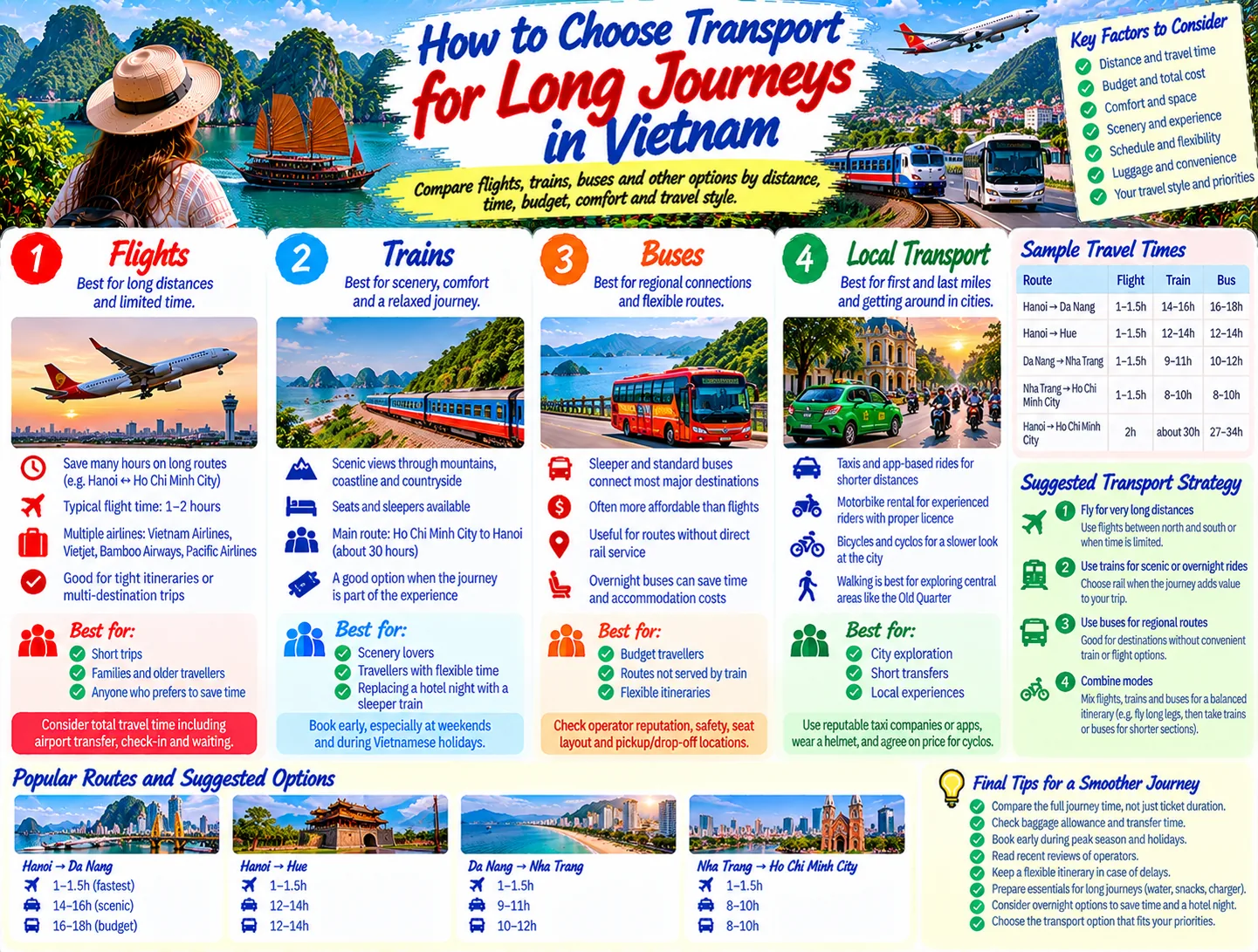
Vietnam is long, and the best way to move between its major destinations depends less on finding one “best” vehicle than on matching transport to your time, budget, comfort level, and route. A short flight can protect a tight itinerary; a train can turn a long transfer into part of the experience; a sleeper bus can connect places that do not have convenient rail service. This guide gives you a practical way to choose, book, and combine transport in Vietnam without treating every journey as a race.
Start with the distance, not the vehicle
Look at your itinerary as a series of travel days. A journey between Hanoi and Ho Chi Minh City is not the same planning problem as a short hop between Hue and Da Nang. Vietnam’s official tourism authority notes that train travel between the two ends of the country can take up to about 30 hours, while journeys from Central Vietnam to either end can commonly take around 16 hours. That makes the flight-versus-train decision especially important on a first visit.
Use this simple filter:
Choose a flight when the transfer would consume a large part of a valuable holiday day or when you need to connect distant regions.
Choose a train when the route itself matters, you prefer an overland journey, or a sleeper can replace a hotel night without making the itinerary exhausting.
Choose a bus when you need a flexible connection to a destination or corridor served more directly by road than rail.
Choose a local ride—taxi, app-based car, bicycle, or motorbike—for the first and last miles rather than the whole intercity journey.
For a broader overview before you make route-by-route decisions, see How to Travel Around Vietnam: Trains, Flights, Buses and More. It is useful background; the framework below is designed to help you decide between options for a particular trip.
When flying is the smarter choice
Domestic flights are usually the strongest option for long north-south distances and for itineraries with limited time. The official tourism guide describes flying as the most convenient way to see several destinations in Vietnam when time is short, with one- or two-hour flight segments often replacing much longer overland journeys. The real saving is not only time in the air. It is the time you keep for walking, eating, visiting a museum, or recovering from jet lag.
Build in the time airports actually require
A flight is not a door-to-door one-hour transfer. Add the journey to the airport, check-in and security, time on the ground after landing, and the ride into town. Compare that total with a train station near your accommodation or a bus that drops you close to the center. A flight may still win, but making the full comparison prevents a misleading “flight time” calculation.
Use flights selectively
Flying every leg can make a trip efficient but fragmented. A better pattern is often one long flight followed by a slower regional section. For example, you might fly between the north and central or southern regions, then use train, bus, bicycle, or local transfers for shorter movements. This preserves time where distance is the problem and leaves room for scenic travel where the route is part of the attraction.
Airfares, schedules, baggage rules, and airport procedures change. Check the airline and airport information for your exact date before paying, and avoid building a connection so tight that a modest delay can disrupt the rest of your itinerary.
When trains are worth the extra hours
Vietnam’s railway is a good choice for travelers who value scenery, a slower rhythm, and the experience of crossing the country overland. The official tourism guide describes the rail network as running roughly 2,600 kilometers from Ho Chi Minh City northward, and presents trains as a relaxing way to see the landscape. It also notes that average speeds are modest, so rail is not the fastest answer for a long transfer.
Pick the right train experience
For daytime travel, a soft seat is generally the more comfortable starting point than the hardest class. For overnight travel, compare a sleeper with the price of a hotel night and ask whether you can realistically sleep while moving. A four-berth cabin can suit travelers who want a more enclosed space, while a seat may be fine for a shorter daytime section. Private tourist sleeping cars may appear on selected routes, but availability and quality are route-specific, so verify the exact service rather than assuming every train has the same layout.
Use rail for the journey, not only the arrival
Rail makes particular sense when your route passes through places you want to experience rather than merely cross. A long train ride can be a deliberate transition between regions, especially if you are comfortable giving the journey a full day or an overnight. It is less suitable when you have only a few days and every transfer removes time from a small number of destinations.
Book ahead for holidays and peak periods. The tourism authority also recommends buying several days early on ordinary dates because faster services and preferred seats can sell out. Confirm the current timetable, departure station, class, and passenger details through the official Vietnam Railways channel before finalizing. The rail operator’s current English site provides online ticket access and railway information; use it as a live check rather than relying on an old blog timetable.
How sleeper buses fit into a Vietnam itinerary
Sleeper and open-tour buses can be practical for routes where road service is more direct than rail. Vietnam’s tourism authority identifies regular bus connections among popular destinations including Hanoi, Hue, Hoi An, Nha Trang, Da Lat, Mui Ne, and Ho Chi Minh City. Buses can also be useful for travelers who want to move between smaller stops without returning to a major railway station.
Ask what “sleeper” means for your trip
Bus layouts vary. Some vehicles have deep-reclining seats; others have individual berths with limited room for large luggage. Before booking, check the departure and arrival points, whether the bus uses a central office or a roadside pickup, and whether the listed arrival time is an estimate. A low fare is less useful if the station is far outside town or the journey does not fit your sleep schedule.
Protect the next morning
An overnight bus may save a hotel night, but it does not guarantee a full night’s sleep. Avoid scheduling a demanding activity immediately after arrival. If a bus reaches a destination early, confirm whether you can leave luggage somewhere and begin with a flexible plan. During Vietnamese holidays, reserve earlier than you would for a normal week; the official tourism guidance recommends booking at least two weeks ahead for holiday travel.
For families, older travelers, or anyone prone to motion sickness, compare a daytime train with a sleeper bus rather than choosing by price alone. Road conditions, rest stops, seat position, and the operator’s boarding process can materially change the experience.
Choose transport by traveler type
For a first-time visitor with seven to ten days
Limit major transfers. Flying can connect two distant regions, while train or bus rides can serve one carefully selected corridor. A common mistake is trying to cover Hanoi, Ha Long Bay, Ninh Binh, Hoi An, Hue, Ho Chi Minh City, and the Mekong Delta in one short trip. Transport convenience cannot fully repair an overpacked route. The site’s Vietnam Travel Itineraries category can help you compare slower and faster trip structures before you book.
For a budget-conscious traveler
Compare the complete cost: ticket, airport or station transfers, baggage, meals during the journey, and any extra hotel night caused by an inconvenient arrival. A bus is not automatically cheapest once a long transfer and a missed activity are included. Trains can offer a useful middle ground when you want comfort and scenery without paying for a flight on every long leg. For budgeting principles that apply beyond transport, see Vietnam Travel Budget.
For families and groups
Choose predictability over the lowest headline price. A flight may reduce fatigue on a long route, while a train cabin can keep a group together and make luggage easier to manage. Discuss motion sickness, bathroom access, bedtime, and arrival time before choosing a sleeper bus. If you are coordinating several travelers, the guide to Planning Vietnam Travel for Families and Groups offers a useful companion framework.
For independent and adventure-oriented travelers
Motorbikes and bicycles can be excellent for short local exploration, but they should not be treated as a default substitute for intercity transport. The official tourism guide emphasizes wearing a helmet, securing a parked motorbike, and taking care on Vietnam’s streets. If you are not already a confident rider, use a professional transfer or another form of transport for long distances and keep cycling or riding to routes you can manage safely.
Make transfers easier with a simple booking routine
Write down the exact origin and destination. “Hanoi to Hoi An” may involve a flight to Da Nang and a separate ground transfer; it is not one single transport product.
Check the station or airport location. A distant terminal can change the best departure time and the true cost.
Confirm the date, passenger names, and baggage terms. Use the operator’s current booking page, especially for rail and air travel.
Save the confirmation offline. Keep the booking reference, departure point, and a local-language version of the destination address accessible.
Leave recovery space. Avoid placing a non-refundable tour immediately after a long overnight journey unless you have a realistic buffer.
Keep your transport plan flexible where possible. Weather, maintenance, traffic, and operational changes can affect departures. A route with one sensible backup is more resilient than a tightly chained itinerary that assumes every connection will run perfectly.
Link transport choices to where you stay
Accommodation location changes the value of every transport option. A hotel near a central station may make rail simple; a place far from the airport can erase some of the time saved by flying. Before booking a room, check how you will reach it at the actual arrival time and whether the neighborhood is convenient for your next departure. The guide Where to Stay in Vietnam: Best Areas for Every Trip can help you think about location alongside travel style, not just room amenities.
Within cities, use the simplest reliable final-mile option for your luggage and arrival hour. In smaller towns, ask your accommodation for the current pickup convention rather than assuming a map pin tells the whole story. A short local transfer is often the part of a journey that needs the most practical attention.
A decision checklist for your next route
Before you buy, answer five questions:
How many usable hours will this option leave me at the destination?
Does it arrive near my accommodation or require another complicated transfer?
Will I sleep, rest, or work comfortably enough during the journey?
What are the total costs after baggage and local transfers?
What is my backup if the service changes or I arrive tired?
If distance is the main problem, start with a flight comparison. If the route is part of the experience, compare a train. If direct road access matters most, evaluate a sleeper bus. Then use local transport only for the short sections where it is genuinely convenient.
Conclusion: choose the journey that supports the trip
The best transport in Vietnam is the option that protects the shape of your itinerary. Flights are powerful time-savers on long routes; trains reward travelers who enjoy scenery and a slower crossing; buses fill important road connections; and local rides complete the journey. Decide by total travel time, comfort, location, and recovery—not by ticket price or headline speed alone. With one or two well-chosen long transfers and enough flexibility around them, getting around Vietnam becomes part of the trip rather than an obstacle to it.
JOIN THE CONVERSATION
Comments (0)
No comments yet. Be the first to share a thought.