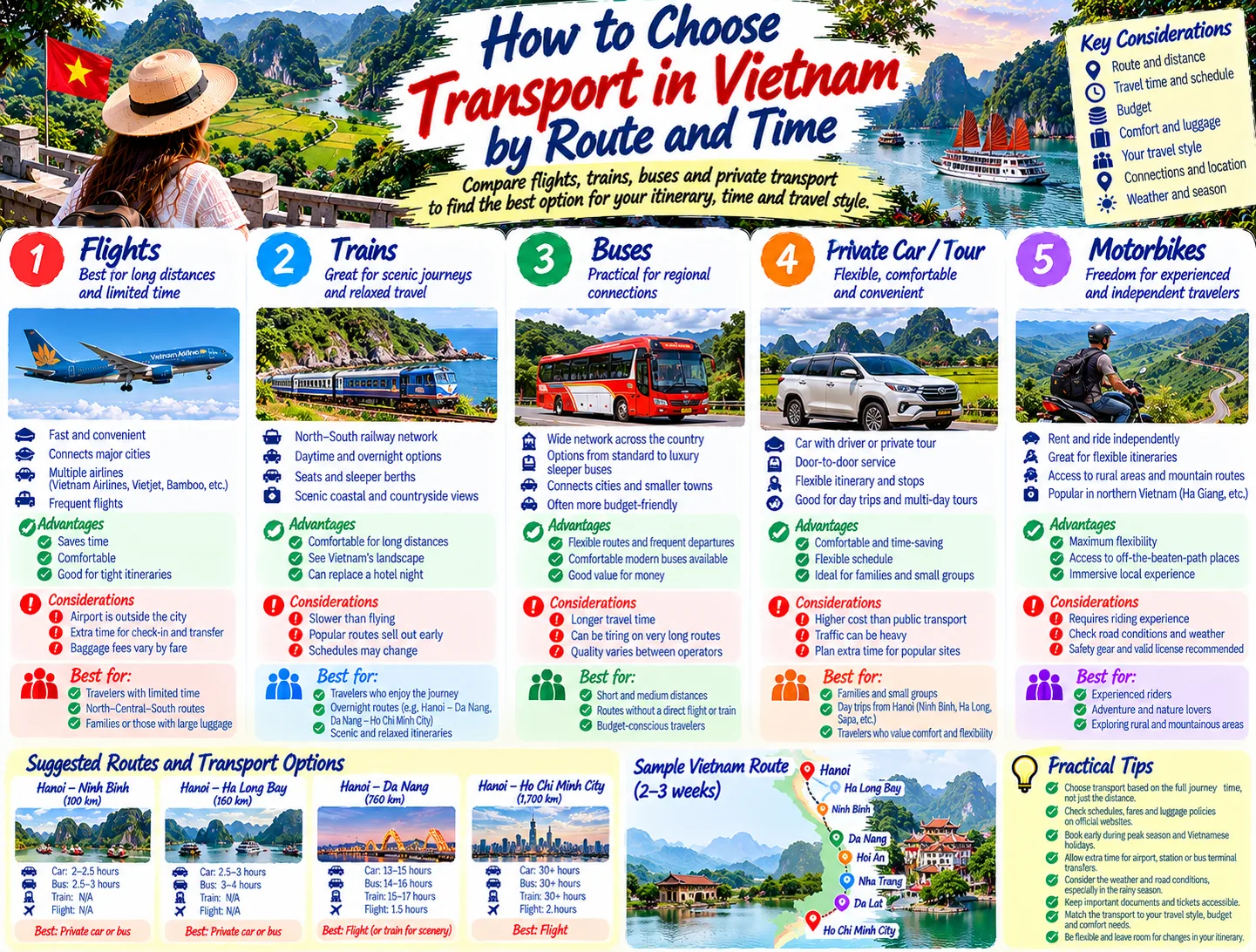
Vietnam is long, varied and surprisingly flexible to explore, but the best way to travel depends on more than the distance between two dots on a map. A short flight can protect a tight itinerary, a train can turn an overnight journey into part of the experience, and a bus can connect places that do not have a convenient rail route. This guide to transportation in Vietnam helps you choose by route, time, comfort, luggage and travel style rather than by habit.
Start with the shape of your Vietnam itinerary
Before comparing tickets, look at the order of your stops. Vietnam stretches from Hanoi in the north to Ho Chi Minh City in the south, with major choices in between such as Ninh Binh, Hue, Da Nang, Hoi An, Nha Trang and Da Lat. Crossing the country by land can be memorable, but it can also consume a large part of a short holiday. The official Vietnam Tourism transport guide notes that train journeys between the two main cities can take up to about 30 hours, while some central-to-north or central-to-south journeys commonly take many hours. That makes route design the first transportation decision.
Use a simple rule: fly when the journey would remove a full sightseeing day, take the train when the route itself is part of the trip, and use a bus when it gives you a practical city-to-city connection without an awkward transfer. If you are still arranging your stops, the site’s Vietnam Travel Itineraries category can help you compare a slower north-to-south plan with a more focused regional route.
Short trip: concentrate on one region and reduce long transfers.
Two weeks or more: combine flights with one or two scenic overland legs.
Flexible trip: leave some room for weather, delays and a change of pace.
Flights in Vietnam: best for long distances and limited time
Domestic flights are usually the clearest choice when you are moving between far-apart regions. Vietnam Tourism describes flying as the most convenient option for travellers who want to see several destinations in limited time, and identifies Vietnam Airlines, Vietjet, Bamboo Airways and Pacific Airlines among the domestic carriers. The practical advantage is not only the time in the air: avoiding a very long road or rail journey can give you an extra morning or evening at your destination.
When a flight makes sense
Consider flying between Hanoi and central or southern Vietnam, or between Ho Chi Minh City and northern destinations, when your itinerary is short. It is also useful for travellers who do not sleep well on overnight transport, families who need a predictable arrival, and anyone carrying a plan with fixed tours or accommodation.
What to check before booking
Compare the full journey, not just the flight duration. Add the time needed to reach the airport, check in, pass security, collect bags and continue to your hotel. Airport transfers can be especially important when an airport sits outside the city centre. Check baggage conditions on the fare you are considering, keep identification and booking details accessible, and avoid placing a same-day non-refundable excursion too close to arrival.
Domestic schedules and fares change. Use the airline’s current booking page for the exact date, airport and baggage allowance rather than relying on an old timetable or a quoted fare. For a wider planning framework, see How to Travel Around Vietnam: Trains, Flights, Buses and More. You can also compare the practical trade-offs in Getting Around Vietnam: Choosing the Right Transport.
Trains in Vietnam: choose the journey as well as the destination
Vietnam’s railway is a strong option for travellers who want scenery, more space to move than a bus usually offers, or an overnight journey that can replace a hotel night. The national railway operator describes the country’s rail network as linking the north and south, while the tourism authority presents trains as a slower way to see the landscape. Rail is particularly attractive on routes where the station is reasonably convenient and you value the experience of travelling overland.
Seats, sleepers and the comfort decision
For a daytime trip, compare hard and soft seating options shown by the operator. For an overnight route, a sleeper can be worth considering if arriving rested matters more than paying the lowest fare. A berth also gives you a place to settle luggage and sleep horizontally, but a cabin is still a shared space unless a private arrangement is explicitly available. Read the current fare and carriage details before paying, since service layouts can vary by train.
How to plan a rail departure
Allow time to reach the station and locate the correct platform. Keep your booking reference, passport or other required identification, and hotel address easy to find. Vietnam Railways provides an online ticket route from its official website, and the national operator’s site also publishes passenger information and railway notices. Use the official booking channel or a reputable agency, compare the passenger name carefully, and save a copy of the confirmed ticket offline.
Book earlier for popular dates, holiday periods and the most desirable sleeper berths. The tourism authority specifically advises advance planning during Vietnamese holidays and notes that same-day travellers may find the faster services and better seats already taken. Verify the current departure time immediately before travel because engineering work, seasonal changes or operational notices can affect a journey.
Buses in Vietnam: useful for regional connections
Buses often fill the gaps between railway stations, airports and smaller destinations. Sleeper buses and deep-reclining seats are common on long-distance routes, and open-tour services connect many well-known stops in central and southern Vietnam. A bus can be a good fit for a traveller who wants a direct point-to-point connection, is staying near the departure office, or is travelling a route where the train would require a detour.
Questions to ask before choosing a bus
Does the service depart from a central office, a station or a roadside pickup point?
Is the seat a normal coach seat, a reclining seat or a sleeper berth?
Are there planned rest stops, and where will luggage be stored?
Does the operator offer hotel pickup, and does that create extra collection time?
Do not judge a bus only by its advertised travel time. Traffic, roadworks, weather and multiple pickups can change the actual arrival. Keep valuables and medication with you, confirm the pickup location on the day, and avoid booking a tight connection immediately after a long overnight service. The official tourism guide recommends booking one or two days ahead for ordinary travel and further ahead around major Vietnamese holidays; treat that as a planning principle and confirm current availability with the operator.
Budget-conscious travellers can combine bus travel with the advice in the site’s Vietnam Travel Budget category, especially when comparing a cheaper ticket with the cost of an extra night, airport transfer or taxi at the other end.
Motorbikes, taxis and local transport
Within a city or beach town, the best transportation in Vietnam is often a short local ride rather than an intercity vehicle. Taxis, app-based cars, buses, cyclos, walking and bicycles can all have a place depending on the neighbourhood and your comfort. Vietnam Tourism describes motorbikes as a convenient way to cover short distances, while also warning novice riders to be careful on Vietnam’s streets and to wear a helmet.
Renting or riding a motorbike
A motorbike can provide freedom in smaller towns and rural areas, but it is not automatically the easiest choice. Consider traffic, road surface, rain, navigation, parking and your experience on a scooter before renting. Confirm what documents the rental company requires, inspect the bike and photograph existing damage, ask how roadside support works, and never assume that a rental agreement resolves local legal or insurance questions. If you are not confident riding in dense traffic, use a car or taxi instead.
Choosing taxis and short rides
For airport or station transfers, use a clearly identified taxi or a reputable ride-booking service, check the destination in the app or on a map, and keep the address of your accommodation written in Vietnamese as well as English when possible. At busy arrival points, patience and a clear pickup point matter more than rushing into the first vehicle offered. Review current local guidance in the site’s Vietnam Travel Safety category before your trip.
How to choose by traveller type
First-time visitors
Use a simple combination: fly one long leg, take a train on a scenic or convenient section, and use pre-arranged local transfers for the first arrival in each city. This reduces decision fatigue without removing the chance to experience overland travel.
Families and groups
Compare door-to-door time and coordination effort. A group may save money with a private transfer on a short route, while a train can let everyone sit together and move around more easily than a cramped road journey. Leave extra time for bathroom stops, food and collecting luggage.
Slow travellers and photographers
Choose land transport where the landscape, stations and changing towns are part of the appeal. Daytime rail or a carefully selected bus can make the transfer feel like an excursion. Keep your camera and important items accessible, and avoid building the entire trip around a single connection that leaves no recovery time.
Travellers with limited mobility
Ask the operator, hotel and transfer provider precise questions before booking: how many steps are involved, whether there is a lift, where luggage is handled, and how far the vehicle stops from the entrance. Accessibility can vary by station, vehicle and destination, so a confirmed arrangement is safer than assuming that a listed service will meet your needs.
A practical booking sequence
Build your transport plan in this order:
Mark the regions you genuinely want to visit and remove stops that create exhausting zigzags.
Identify the two or three longest transfers and compare flight, rail and bus door-to-door time.
Choose one primary option and one backup for each important move.
Check the official operator or booking channel for the current date, passenger details, baggage rules and cancellation conditions.
Reserve accommodation only after confirming where the arrival point is and how you will reach it.
Save tickets, station names, pickup instructions and hotel addresses offline.
Keep a buffer after an overnight journey, a flight and any connection involving separate tickets. If a delay would make you miss a non-refundable activity, the itinerary is too tight even if the timetable looks possible.
Common transportation mistakes to avoid
The most common error is treating Vietnam as if every city were equally close. Another is comparing ticket prices without adding airport transfers, luggage charges, hotel nights or lost sightseeing time. Travellers also sometimes book the wrong station, confuse a city-centre office with a terminal, or assume a sleeper bus will be comfortable for every body type.
Read the full booking confirmation, check the date format, confirm the passenger name and identify the exact departure point. For trains, use the official railway information available at the time of booking. For buses and local transfers, ask the provider to confirm the pickup details in writing. Recheck live information before leaving your hotel, especially around holidays or severe weather.
Conclusion: match the vehicle to the trip
The best way to travel around Vietnam is rarely one single mode. Flights protect time, trains add an overland experience, buses connect regional destinations, and local rides solve the final kilometre. Plan the route first, compare the complete door-to-door journey, choose the comfort level you can sustain, and verify current details with the operator. With that approach, transportation becomes part of a flexible Vietnam itinerary rather than the source of avoidable stress.
JOIN THE CONVERSATION
Comments (0)
No comments yet. Be the first to share a thought.