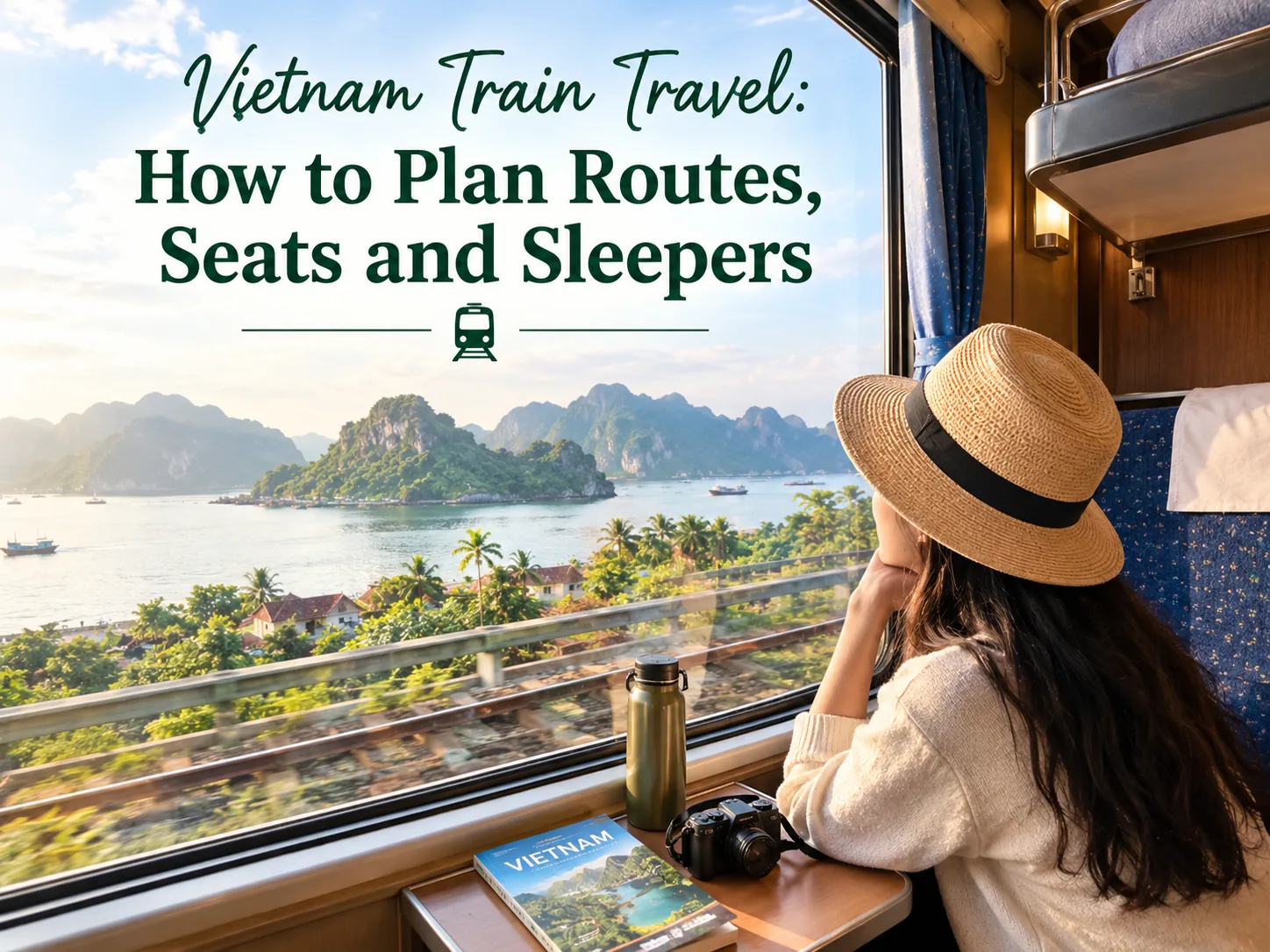
Vietnam’s long north–south shape makes transport a planning decision, not a small detail. A route that looks short on a map can take most of a day by road, while a train journey can turn the distance into a slower, more scenic part of the trip. This Vietnam train travel guide explains when rail is the right choice, how to choose seats or berths, how to book sensibly, and how to fit trains into an itinerary without losing valuable time.
When train travel is the best choice in Vietnam
Trains work best when you want to connect major destinations overland and value the journey itself. Vietnam Tourism describes the rail network as a relaxing way to see the country, with the north and south connected by a long route managed by Vietnam Railways. The pace is slower than flying, but that can be an advantage: you avoid an airport transfer, watch the landscape change, and arrive in a central station rather than an out-of-town terminal.
Choose a train when at least one of these is true:
You want an overnight journey that saves a hotel night and preserves daytime for sightseeing.
You are travelling between destinations where the scenery matters as much as speed.
You prefer a fixed rail route to negotiating a long road transfer.
You are carrying luggage and would rather settle into one seat or berth than change vehicles.
Flying is usually the better fit when your itinerary is short, your dates are tight, or you are crossing a large part of the country. The official tourism guidance notes that long rail journeys can take many hours, so compare the full journey: getting to the airport, check-in time, transfers after landing, and the value of the time saved.
Which Vietnam train route fits your itinerary?
North–south journeys
The main railway corridor links Hanoi with Ho Chi Minh City and serves important stops such as Hue, Da Nang, Nha Trang, and other central and southern destinations. You do not need to ride the entire line to benefit from it. A shorter section can be a useful bridge between two stops on a multi-city itinerary, particularly when you want to experience central Vietnam without adding another flight.
For first-time visitors, a practical pattern is to use rail for one memorable segment and fly the longest gap. For example, you might connect Hanoi with a central stop by train, then continue south by air if the schedule is tight. This creates variety without turning every transfer into an all-day commitment. Compare the route against the trip’s rhythm in this first Vietnam itinerary with room to breathe before booking multiple long sectors.
Central Vietnam connections
Rail is especially attractive when the route itself is part of the experience. A train between northern and central destinations can make sense for travellers who want to see more of the coast and countryside from ground level. Check the arrival station carefully, however: the station name is not always the same as the neighbourhood or resort where you will stay, so include the onward transfer in your plan.
Shorter scenic sections
A short rail segment can be easier to enjoy than a very long one. It gives you a taste of Vietnam train travel without forcing you to sacrifice a full day or sleep on board. If you are building a route around landscapes, food, and historic cities, treat the train as one experience within the itinerary rather than the default for every movement.
How to choose seats, sleepers, and cabins
Vietnam trains commonly offer a range of comfort levels, from harder seating to softer seats and sleeping berths. Vietnam Tourism specifically recommends considering soft seats and four-berth cabins when you want more comfort, while private tourist sleeping cars may be available on selected routes. The right choice depends on the length of the journey, your sleep habits, and how much privacy you need.
Soft seat: a reasonable choice for daytime travel or shorter sections when you want to read, look outside, and keep the cost controlled.
Hard seat: best reserved for travellers who prioritise the lowest possible fare over space and quiet.
Four-berth sleeper: a strong compromise for an overnight train because it gives you a proper berth and fewer occupants than a larger compartment.
Private tourist carriage: consider this only when the route and operator details are clearly shown at booking and the extra comfort is worth the premium.
For an overnight journey, do not choose solely by fare. Ask how you will feel on arrival. A cheaper seat may look attractive until it leaves you too tired to enjoy a full day. Conversely, a sleeper can be poor value if you are travelling a short daytime section and would rather watch the scenery. If you are travelling as a family or group, review the family and group travel planning guidance and decide whether keeping everyone in one compartment matters more than selecting the cheapest individual seats.
Booking Vietnam train tickets without creating stress
Vietnam Railways operates the official online ticketing entry point, and the official tourism authority also identifies station counters, travel agencies, and online booking as possible ways to buy tickets. Start with the official source when you want to confirm the route, date, station, and available class. The railway ticketing site also provides sections for booking information, train times and fares, ticket changes or returns, and current policies.
Book earlier when your travel dates are fixed, especially around Vietnamese holidays or other peak periods. The official tourism guidance warns that the fastest services and best seats may be gone when travellers wait until the day of departure. You do not need to lock every train into a flexible itinerary months ahead, but you should avoid treating popular overnight berths as a last-minute detail.
Use the station and date as your first checks
Vietnamese cities can have more than one transport hub, and a station’s official name may differ from the place name used by hotels or tour listings. Before paying, check the departure station, arrival station, travel date, class, berth preference, and passenger names exactly as requested by the booking system. Save the confirmation in a format you can show offline, particularly if your mobile connection may be unreliable during a transfer.
Build in a booking fallback
Schedules, availability, and policies can change. If a preferred departure is unavailable, keep a second train, a different class, or a flight as a backup rather than forcing the rest of your itinerary around one seat. For broader planning, compare the rail option with the decision framework in the site’s guide to trains, flights, buses, and other transport.
Planning the day around an overnight train
An overnight train is not automatically a free night. You still need time to reach the station, locate the correct platform or carriage, board with your luggage, and get from the arrival station to your accommodation. Put a buffer between arrival and any non-refundable tour, timed attraction, or long onward transfer. If you arrive early, ask your accommodation whether it can hold bags before check-in; do not assume the room will be ready.
Keep the first morning after an overnight journey deliberately light. A café, a neighbourhood walk, or a flexible museum visit is safer than booking the most demanding activity of the trip. If you are connecting straight to another vehicle, make sure the plan has room for delays and the practical time needed to leave the station.
Pack for a compact personal routine rather than a full hotel setup. Keep water, a light layer, tissues, medication, headphones, and essential documents where you can reach them without opening your main suitcase. Use a small day bag for the berth and keep valuables with you. These are planning habits, not a substitute for checking the railway’s current conditions and policies.
Stations, luggage, and arrival logistics
Rail travel is often convenient because stations are closer to city centres than airports, but “central” does not mean door-to-door. Confirm the station’s location and your hotel’s exact address before departure. Arrange the final taxi, ride-hailing trip, walking route, or local connection only after checking arrival time and luggage needs.
Vietnam Tourism notes that luggage transport and freight-forwarding service is available on Reunification Express trains. Treat this as an option to verify for your specific journey rather than a promise that every booking includes it. Most travellers will find it simpler to keep luggage manageable enough to carry through the station, onto the carriage, and to the next vehicle.
For a smoother station experience:
Arrive with enough time to match the booking to the correct train and carriage.
Keep the ticket or booking reference accessible, not buried in checked luggage.
Use a bag size you can lift and move without blocking the aisle.
Confirm your arrival transfer before departure, but keep a backup option.
Train, flight, or bus? Make the decision by trip style
There is no single best way to travel around Vietnam. The official tourism transport overview presents flights, trains, buses, motorbikes, and cycling as complementary options. Use that principle instead of ranking every mode from best to worst.
Choose a flight when distance and limited holiday time are the main constraints.
Choose a train when you want an overland experience, a central arrival, or an overnight berth.
Choose a bus when the route is well served and your priority is a direct budget connection; verify the operator, pickup point, and vehicle type.
Choose a motorbike or bicycle only when your experience, route, weather, and local conditions make that choice appropriate.
Cost should be compared with time, rest, convenience, and transfer complexity—not just the ticket price. Your Vietnam travel budget planning should include station transfers, meals during a long journey, and the possibility that a cheaper ticket costs you a valuable sightseeing day.
A simple Vietnam train booking checklist
Before finalising a rail segment, run through this short checklist:
Does the train connect places that belong in the same itinerary, or is it adding distance for its own sake?
Have you compared the full rail journey with a flight, including airport and station transfers?
Is the selected class suitable for the duration and for your sleep needs?
Have you checked the official booking system for the exact date, stations, fare, and current rules?
Do you have a realistic arrival plan and a buffer before your next fixed commitment?
Can you carry your luggage through the station and onto the carriage?
Have you saved the booking details and prepared a backup if availability changes?
Final advice for a smoother rail journey
The best Vietnam train itinerary is selective. Use rail for the sections where its scenery, central stations, or overnight convenience genuinely improve the trip, and use flights or buses when they protect scarce holiday time. Book the class that supports your energy, verify every operational detail through the current official ticketing channel, and leave breathing room around arrival. With that balance, the train becomes more than a transfer: it becomes one of the memorable ways to understand Vietnam’s length and variety.
JOIN THE CONVERSATION
Comments (0)
No comments yet. Be the first to share a thought.