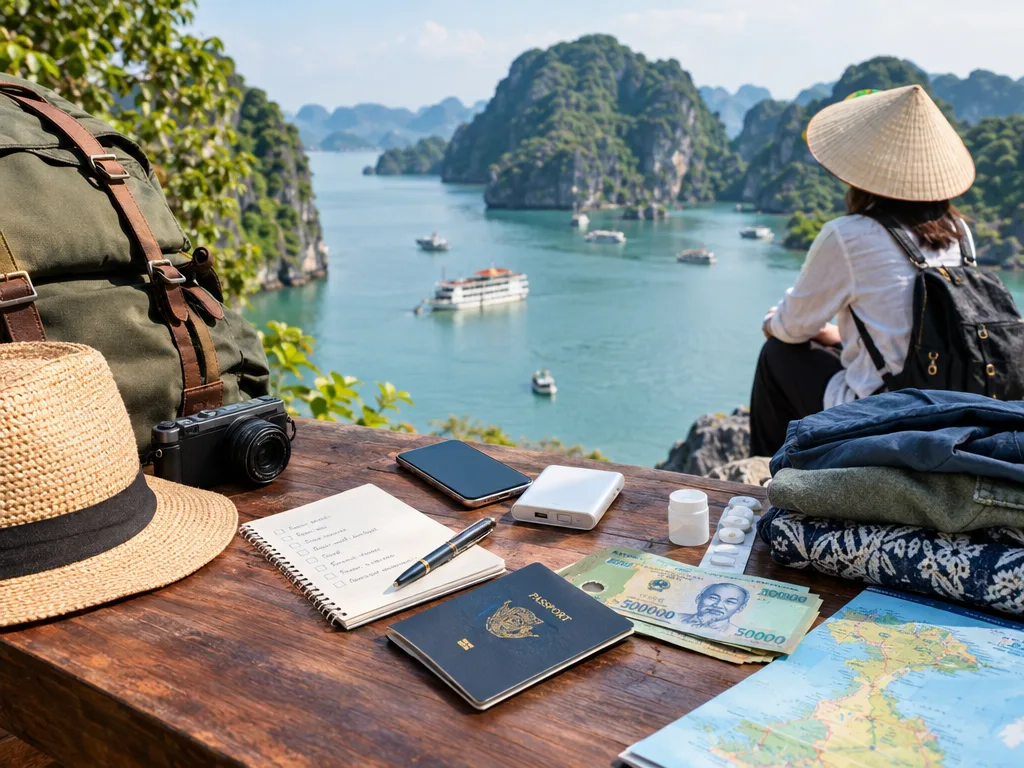
Vietnam is easier to enjoy when the small practical decisions are made before departure. A useful Vietnam travel essentials checklist is not about packing every possible item or planning every hour. It is about preparing the documents, money, connectivity, clothing, health supplies, and arrival details that prevent avoidable stress once you land.
This guide focuses on the questions travellers often ask just before a first trip: what to carry, how much access to money and communication to arrange, what to expect from transport and weather, and which habits make daily travel smoother. Use it as a final review alongside current official entry advice and your airline’s instructions.
Start with the documents you will actually use
Keep your essential documents together in both physical and digital form. Your passport should be valid for the period required for your nationality and travel situation, and you should confirm the latest Vietnam entry rules before booking or flying. If you need an e-visa or another authorization, check every field against your passport rather than relying on memory or an old application.
- Passport and a secure digital copy of the identity page.
- Visa, e-visa approval, or evidence of visa exemption if applicable.
- Flight, rail, hotel, and tour confirmations for the first part of the trip.
- Travel insurance details and an emergency contact.
- Prescriptions, medical letters, and a note of important allergies.
Save the first-night accommodation address in a form you can show without an internet connection. Include the Vietnamese spelling if it appears on your booking confirmation. This can help when speaking with a driver, checking into accommodation, or completing an arrival form.
Do not assume a screenshot is enough for every document. Keep a small printed backup in a separate part of your luggage, while leaving the original passport in a secure but accessible place. A simple folder system is better than carrying loose papers through several transfers.
Prepare money for both cards and cash
The local currency is the Vietnamese đồng, written as VND or ₫. Vietnam Tourism explains that notes range from smaller paper bills to larger polymer notes and that coins are not used in everyday circulation. The number of zeros can feel unfamiliar at first, so pause and check the denomination before handing over a note. Similar-looking blue notes deserve particular attention.
Use a two-part payment plan. Carry at least one card for hotels, larger restaurants, tours, and other businesses that accept international payments, but also keep local cash for street food, small shops, markets, short rides, tips, and places outside major visitor areas. A second card stored separately is useful if a bank declines a transaction or a wallet is lost.
Before departure, ask your bank about overseas transactions, cash-withdrawal fees, travel notifications, and whether your card requires a PIN. When an ATM or payment terminal offers a currency conversion choice, compare the options carefully and avoid accepting a conversion you do not understand. Keep withdrawal receipts until you have checked your statement.
Split your cash rather than putting it all in one wallet. A small daily amount can stay easy to reach, while the rest remains secured at your accommodation or in a money belt used discreetly. Vietnam Tourism notes that ATMs and exchange services are available in major arrival points and cities, but remote destinations may offer fewer convenient options. Withdraw or exchange enough before leaving a city when your itinerary becomes rural or island-based.
Arrange connectivity before you need directions
Decide how you will get online on arrival: roaming, an eSIM, a local SIM, or Wi-Fi only. There is no single best choice. An eSIM can be convenient for a compatible unlocked phone, while a local SIM may suit travellers who want a local number. Roaming is simple but can be expensive, and Wi-Fi-only travel requires more preparation.
Download offline maps for your first destinations and save the addresses of airports, hotels, stations, and meeting points. Store booking confirmations, translation notes, and emergency contacts on your phone before leaving home. Make sure you know the screen-lock code and that your important accounts can be recovered if the phone is lost.
A compact power bank can help on long transfer days, but check airline rules for carrying batteries. Vietnam generally uses common two-round-pin and flat-pin plugs, yet sockets vary by property. A small universal adapter is a practical choice, especially if you are moving between hotels, homestays, and older buildings. Pack charging cables in your day bag rather than in checked luggage.
Download a translation tool and prepare a short note with your accommodation name and address. A few Vietnamese phrases such as “xin chào” for hello, “cảm ơn” for thank you, and “bao nhiêu tiền?” for how much is this can make routine interactions friendlier, even when you continue in English or use a translation app.
Pack for regions, not one nationwide forecast
Vietnam stretches from cooler northern areas to tropical southern destinations, and conditions can differ between coast, city, mountains, and delta. Instead of packing for an imaginary average Vietnam temperature, check the forecast for each region and month on your route. A trip that combines Hanoi, central Vietnam, and the Mekong Delta may need more variety than a short beach stay.
- Light, breathable clothing for warm and humid days.
- A thin layer for air-conditioned transport, mountain evenings, or northern winter conditions.
- Comfortable shoes with grip for uneven pavements, wet streets, and walking tours.
- Sun protection: sunglasses, a hat, and sunscreen.
- A compact rain layer or umbrella when showers are possible.
- Modest clothing that covers shoulders and knees for religious or formal sites.
Choose quick-drying fabrics and pack less than you think you need. Laundry is widely available in tourist areas, and lighter luggage is easier on trains, sleeper buses, boats, and short domestic flights. Keep one change of clothes and essential medication in your carry-on in case checked luggage is delayed.
For trekking, caves, boat trips, or motorbike routes, add items that match the activity rather than buying a generic adventure kit. Closed shoes, insect repellent, a dry bag, and a small headlamp may be more useful than extra outfits. Always check the operator’s own equipment and safety instructions before relying on what you packed.
Build a small health and comfort kit
Bring enough of any prescribed medicine for the entire trip, plus a buffer for delays. Keep medication in its original packaging and carry a doctor’s letter when your condition, prescription, or medical device may need explanation. Vietnam Tourism advises travellers with medical conditions or allergies to carry relevant medical information and to seek current advice from a doctor or travel clinic before departure.
A practical personal kit can include sunscreen, insect repellent, basic pain relief, blister care, hand sanitizer, tissues, oral rehydration salts, and any medicines you normally use. Do not start unfamiliar medication casually, and check whether your prescription has entry restrictions before travelling.
Heat, humidity, unfamiliar food, and long transfer days can affect even healthy travellers. Drink water regularly, take breaks from direct sun, and avoid turning the first day into a packed sightseeing marathon. Vietnam Tourism recommends care with drinking water and food choices, particularly in rural areas, while also noting that travellers should use their own judgement with street food.
Travel insurance should match the activities you plan to do. Check whether it covers medical care, cancellations, baggage problems, motorbike use, trekking, water activities, and pre-existing conditions. Save the insurer’s assistance number where you can find it offline.
Plan your first arrival and your transport rhythm
Write down what happens after landing: immigration, baggage collection, cash or connectivity, airport transfer, hotel check-in, and a meal. This simple sequence is more useful than scheduling several attractions immediately. Keep the first evening flexible if you arrive after a long flight or cross several time zones.
Vietnam offers domestic flights, trains, buses, taxis, cyclos, cycling, ferries, and motorbikes. The right choice depends on distance, comfort, budget, luggage, and how much time you want to spend moving. Vietnam Tourism points out that the country is larger than many visitors expect and that overland journeys can take much longer than a map suggests.
Leave realistic margins around transfers. A station, airport, or hotel may be close in kilometres but slow to reach through traffic. Confirm the departure point, not just the city name, and save the booking reference. For a long journey, decide whether a sleeper, soft seat, private transfer, or flight better suits your sleep and mobility needs.
Use reputable, clearly identified transport providers and check the final price before departure. Keep your phone and bags secure during crowded street crossings and rides. If you rent a motorbike, confirm that you are legally permitted and properly insured to ride, wear a helmet, and understand the local road conditions before leaving town.
Know the everyday habits that prevent avoidable problems
Carry your phone and bag on the side away from moving traffic, especially on busy city streets. Keep valuables out of sight, use your accommodation safe when appropriate, and avoid displaying large amounts of cash. These are ordinary precautions, not reasons to avoid exploring.
Dress and behave thoughtfully at temples, pagodas, historic buildings, and community spaces. Follow signs about footwear, photography, offerings, and restricted areas. Ask before photographing people, particularly vendors, children, monks, and ceremonies. A little patience goes a long way in markets and busy transport areas.
Keep your itinerary shareable. Send a trusted person your flight details, first accommodation, and broad route, then update them when the plan changes. Save local emergency contacts and your country’s consular information. If something goes wrong, a calm record of your documents and bookings is more valuable than a perfect travel plan.
Finally, leave room for adjustment. Weather, traffic, fatigue, and local discoveries can change a day. The most useful Vietnam travel essentials are the ones that give you options: accessible documents, two ways to pay, offline information, suitable clothing, basic health supplies, and enough time to make sensible decisions.
Final Vietnam travel essentials checklist
- Check current entry requirements and passport details.
- Save printed and offline copies of key documents.
- Carry a card backup and some Vietnamese đồng.
- Arrange connectivity, maps, translations, and charging.
- Pack for each region, activity, and likely weather pattern.
- Bring prescriptions, basic health supplies, and suitable insurance.
- Confirm arrival transport and keep the first day flexible.
- Protect valuables, respect local sites, and review plans as conditions change.
Use this checklist as a final pre-trip filter, then verify time-sensitive details with official Vietnamese sources, your airline, accommodation, and transport providers. Preparation should make Vietnam feel more open, not more complicated.

JOIN THE CONVERSATION
Comments (0)
No comments yet. Be the first to share a thought.