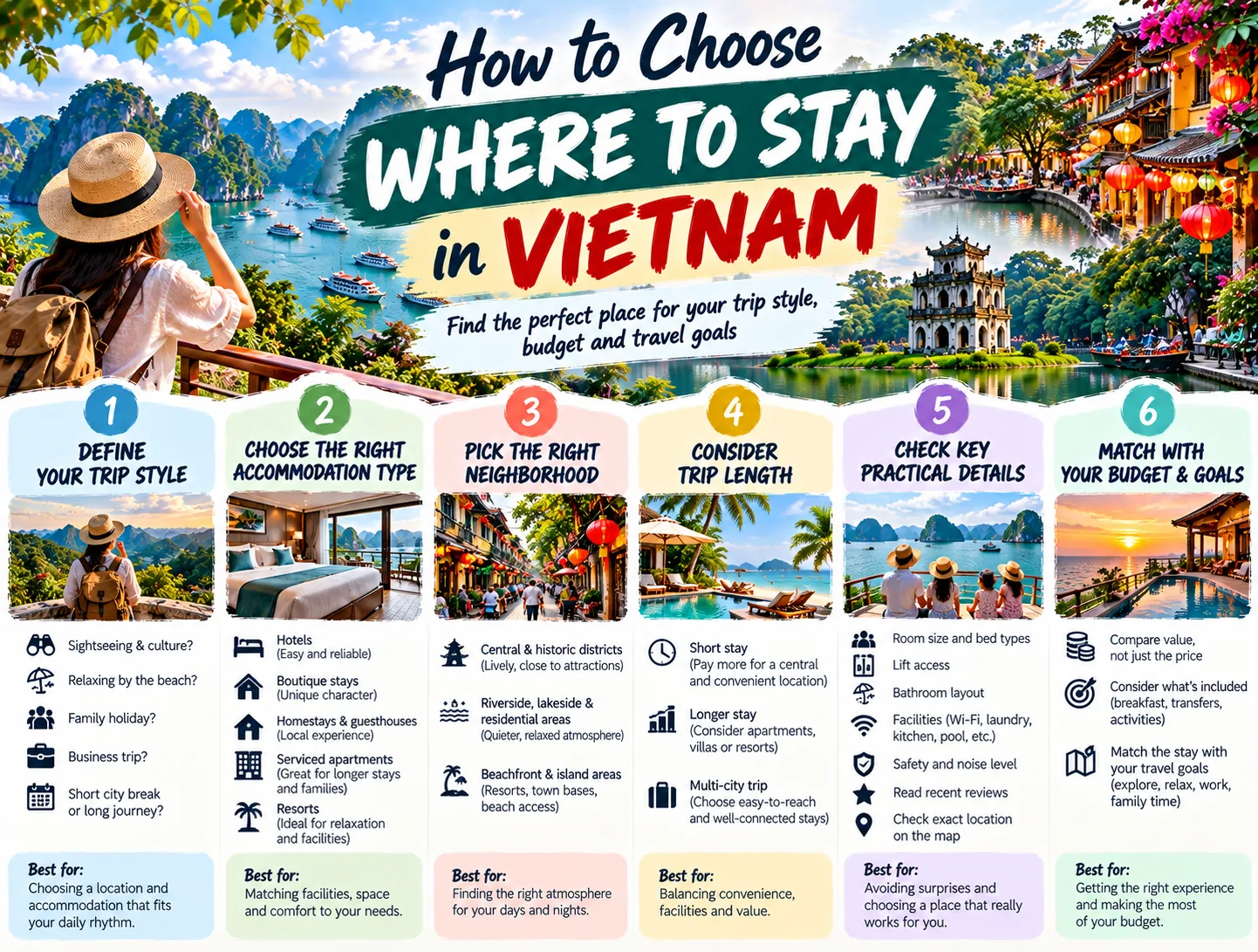
Choosing where to stay in Vietnam is less about finding one “best” hotel and more about matching a base to the way you will spend each day. A beach resort, an Old Quarter boutique hotel, a riverside homestay, and a business-district apartment can all be excellent choices for different trips. This guide gives you a practical way to compare them before you book, whether you are planning a first visit, a family holiday, a short city break, or a longer north-to-south itinerary.
Start with the trip you want, not the room you saw
The most useful accommodation decision is usually the location, followed by the room. Begin by writing down what a normal day should feel like. Do you want to step outside into street food and evening energy, wake up beside the sea, return to a quiet pool after sightseeing, or stay close to a railway station for an early departure? Your answer points toward a different type of base.
Vietnam rewards travelers who choose a base around their daily rhythm. A short city stay may justify paying more for a central address because it reduces time spent getting to the places you came to see. A slower beach holiday may make facilities, space, and easy meals more important than being close to a historic center. A multi-city trip may favor a reliable, easy-to-find hotel near your arrival route rather than the most atmospheric property.
For a broad destination comparison, use Where to Stay in Vietnam: Best Areas for Every Trip. Then use the framework below to narrow your choice by length of stay, mobility, noise tolerance, and the balance between exploring and relaxing.
Match the accommodation type to your travel style
Hotels and boutique stays
A hotel is often the easiest all-round choice for a first Vietnam trip. You can prioritize a clear check-in process, daily housekeeping, a front desk, breakfast, or help arranging onward transport. Boutique hotels can add character and a stronger sense of place, but compare the practical details as carefully as the photographs: lift access, room size, window placement, bathroom layout, and whether the hotel’s public spaces are open to outside visitors.
For a short stay, choose a property that makes your first and last days simple. A memorable design does not compensate for a difficult arrival or a room that does not suit your sleeping habits. Read recent reviews for recurring patterns rather than one dramatic comment, and check the hotel’s exact map pin instead of relying on a neighborhood name alone.
Homestays and guesthouses
Homestays and guesthouses can suit travelers who value conversation, local character, a smaller scale, or a quieter setting. They may be particularly attractive in rural areas and smaller destinations where the accommodation is part of the experience. Before booking, confirm what is private, what is shared, how late arrival works, and what support exists if your transport is delayed.
Serviced apartments and villas
A serviced apartment or villa becomes more useful when you are staying several nights, traveling with children, or sharing costs with friends. Look for the features that will actually change your routine: separate sleeping areas, a usable dining space, laundry access, a refrigerator, and enough bathrooms. Do not assume that “apartment” means a full kitchen or that “villa” means complete privacy; verify the listing details and recent guest comments.
Resorts and retreats
Resorts work best when the property itself is part of the plan. Vietnam Tourism’s family resort guide highlights several ways to compare a resort beyond its beach: multi-bedroom accommodation, children’s clubs, pools, activities, meals, shuttles, and access to nearby attractions. That is a useful checklist for any resort search. If you expect to spend most of your time outside the property, a resort’s extra facilities may not justify its distance or price.
Choose the right neighborhood for your daily rhythm
Central and historic districts
A central or historic district can be a strong fit for first-time visitors, short breaks, and travelers who want to make spontaneous stops between major sights. The trade-off is that central streets can feel busy, lively, or less restful. Check whether your room faces a main road, a late-night venue, a market, or an internal courtyard. “Central” is useful only if it places you near the activities you actually plan to do.
Riverside, lakeside, and residential areas
A waterfront or residential neighborhood may suit longer stays, remote workers, couples, and travelers who prefer cafés, morning walks, or a slower evening. It can also create a more deliberate commute to the historic core. In Hanoi, Vietnam Tourism’s hotel guide presents West Lake/Tay Ho as a distinct accommodation setting from the Old Quarter, while also describing a nature-focused retreat near Ba Vi. The planning lesson is broader than those examples: compare the atmosphere you want at the end of the day, not only the distance to the first attraction.
Beachfront and island bases
For coastal destinations, decide whether you want a resort base, a town base, or a compromise between the two. A resort can simplify meals, recreation, and family logistics. A town base can make it easier to explore local restaurants and divide your time between the beach and other activities. Ask whether “beachfront” means direct access, a view, or simply a property in the wider coastal area.
For more destination-planning context, browse the Family & Group Travel category if you are coordinating multiple ages, rooms, or activity preferences. The right neighborhood is often the one that reduces the number of daily compromises for everyone, not the one with the most impressive hotel lobby.
Use trip length to decide how much location matters
One or two nights
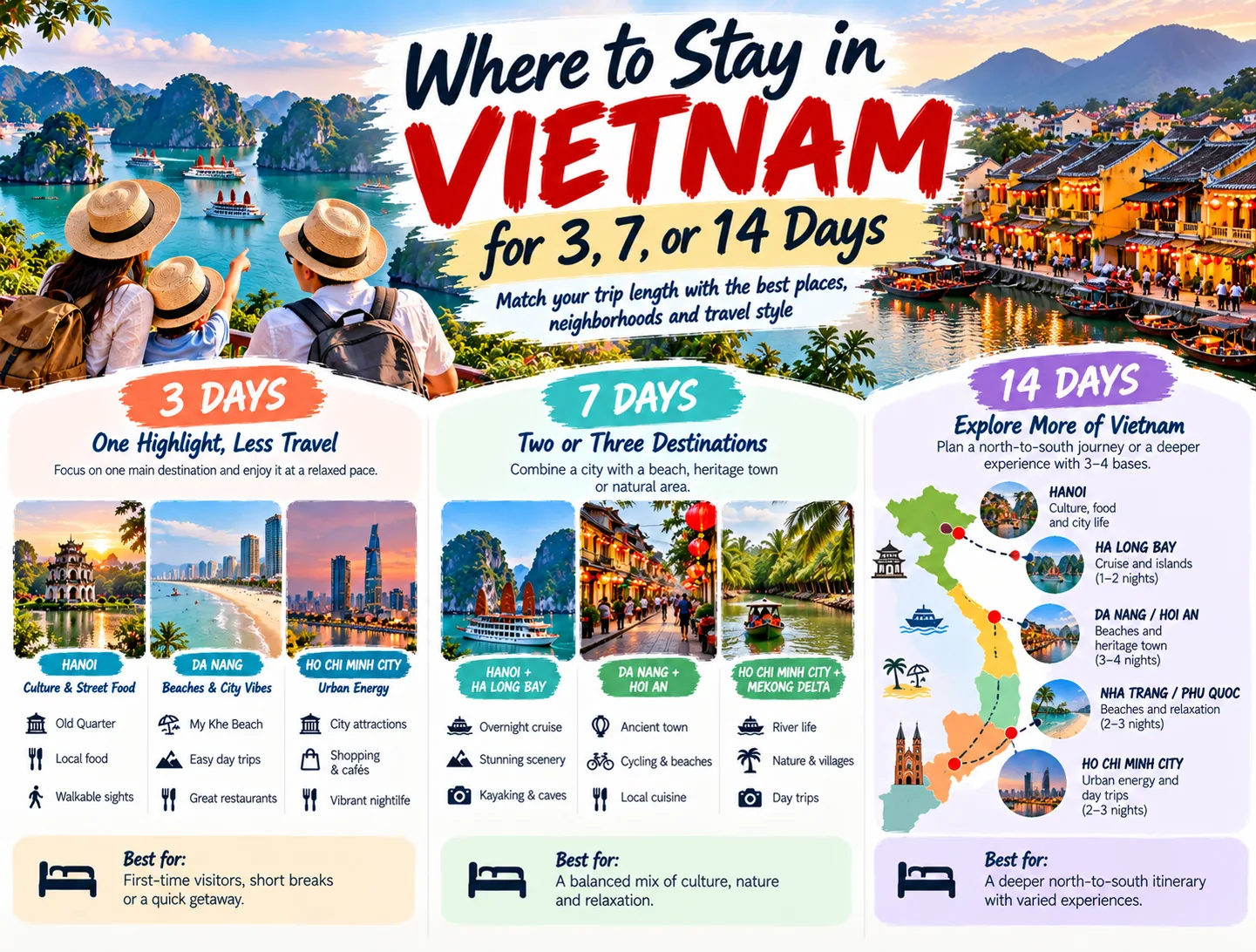
On a brief stop, prioritize arrival simplicity and access to your main plan. A hotel near the sights or departure point can protect valuable time. Keep the decision narrow: choose the best location, then compare cancellation terms, room comfort, and arrival support among a few suitable properties.
Three to five nights
With several nights, neighborhood character becomes more important. You will notice noise, uphill walks, breakfast options, laundry arrangements, and the time required to reach your planned excursions. Consider whether you want to stay in one base or split the visit between two contrasting areas. Moving can add friction, so change hotels only when the different location gives you a clear experience or transport advantage.
A week or longer
For longer stays, prioritize livability. A slightly less central property may be better if it gives you more space, a calmer sleep environment, practical food options, and a routine you enjoy. Confirm the total cost rather than comparing only the nightly headline rate. Include cleaning fees, breakfast, transfers, extra beds, laundry, and any services you are likely to use.
Build a room and facilities checklist
Accommodation descriptions are easiest to compare when you turn them into questions. Before booking, check:
Sleeping arrangement: Is the bed configuration suitable, and can the property provide the arrangement you need without relying on an unconfirmed request?
Noise and light: Does the room face a street, pool, rooftop, lift, or service area? Are there recent comments about sound?
Access: Is there a lift, a manageable staircase, a ramp, or a long walk from the entrance to the room?
Climate comfort: Is air-conditioning or another cooling arrangement clearly listed, and can the controls be used independently?
Work and downtime: Is there a real chair and table if you need to work, or a comfortable sitting area if you expect to spend time indoors?
Family logistics: Are connecting rooms, cots, high chairs, children’s facilities, or babysitting services actually confirmed by the property?
Food: What meals are included, what dietary questions should you ask, and are there practical options nearby if plans change?
Arrival: Can the property explain its entrance clearly to a driver, and is late check-in possible if your transport changes?
Vietnam Tourism’s official hotel platform describes comparing hotels across Vietnam and booking with secure online payment. Treat that as a starting point, not a substitute for reading the individual property’s conditions. Compare like with like, save the confirmation, and check the cancellation deadline in the same time zone shown by the booking provider.
Think about transport before you commit
Accommodation and transport decisions are connected. A beautiful property can become inconvenient if every sightseeing day begins with a long transfer, while a modest hotel can work extremely well when it sits on the right side of your route. If you plan to move between cities, review How to Travel Around Vietnam: Trains, Flights, Buses and More before choosing a hotel for the night before departure.
For each stay, note four points: your arrival station or airport, the location of the first planned activity, the likely departure point, and the time of day you will travel. Then ask whether the hotel can help arrange a transfer, store luggage, or accommodate an early departure. These are planning questions rather than promises; confirm them directly with the property.
If you are comparing several cities, the Transportation in Vietnam category can help you connect hotel locations with the wider route. Keep the final choice simple enough that every traveler can explain where they are staying and how they will reach it.
Book with a risk-aware comparison process
Create a shortlist of three to five properties and score them against the same criteria: location, sleep quality, room suitability, arrival ease, facilities, cancellation flexibility, and total cost. Give the highest weight to the factors that would be difficult to fix after arrival. A smaller room may be manageable; an inaccessible location or an unsuitable sleeping arrangement may not be.
Read the newest reviews first, but do not treat every review as universal truth. Look for repeated, specific observations about noise, cleanliness, staff communication, construction, water pressure, or the accuracy of room photographs. Check the property’s own terms for deposits, identification requirements, age rules, extra occupants, and late arrival. If a detail matters to your trip, ask before paying rather than assuming a generic listing label covers it.
Families and groups should nominate one person to keep the booking record, confirmation number, room assignments, and special requests together. Couples may want to prioritize views, privacy, or a calm evening environment. Solo travelers may prefer a well-used entrance, clear reception hours, and a location that feels straightforward to navigate. The best hotel is the one that solves your actual constraints.
Final booking checklist
Write down your daily priorities before comparing properties.
Check the exact map location, not just the district name.
Match the room type to the people, beds, luggage, and length of stay.
Separate included services from optional paid extras.
Read cancellation, payment, arrival, and occupancy conditions.
Review recent comments for repeated practical problems.
Confirm important requests directly with the property.
Save the confirmation and the property’s contact details offline.
Conclusion: choose the base that makes the trip easier
Where to stay in Vietnam is a decision about time, energy, and daily comfort as much as price. Start with your travel style, choose a neighborhood that supports your rhythm, then verify the room, facilities, arrival plan, and booking conditions. A central hotel may be ideal for a short city break; a residential base may suit a longer stay; a resort may be worth it when its facilities replace complicated daily logistics. Compare deliberately, and your accommodation will support the itinerary instead of competing with it.

JOIN THE CONVERSATION
Comments (0)
No comments yet. Be the first to share a thought.