Choosing where to stay in Vietnam is less about finding one perfect hotel and more about matching each base to the way you want to travel. A compact old quarter can make sightseeing easy, while a beach district may suit a slower holiday but add travel time to museums and markets. This city-by-city guide explains the best areas to stay in Vietnam for first-time visitors, beach breaks, food trips, family holidays and multi-stop itineraries.
How to choose the best place to stay in Vietnam
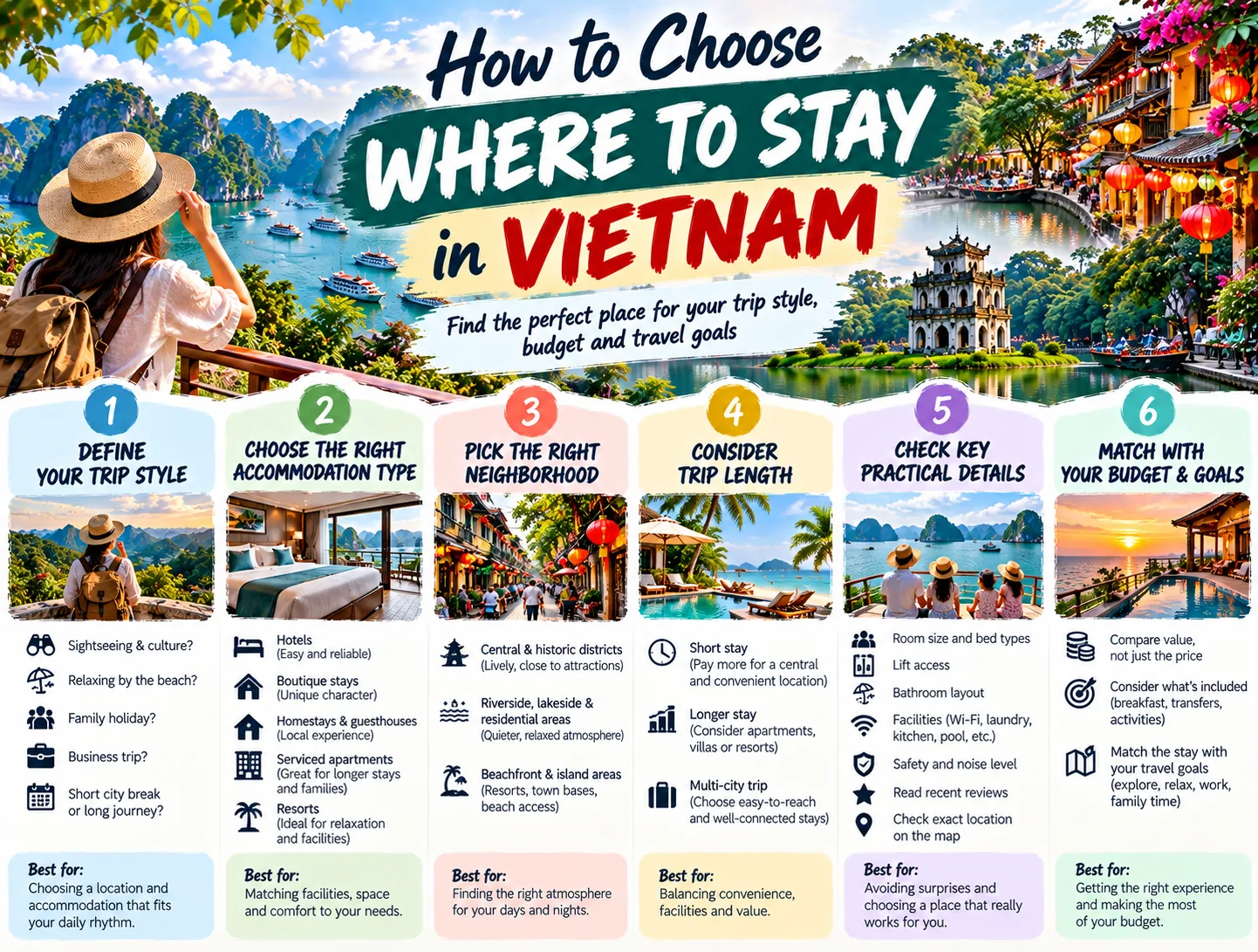
Start with your daily rhythm rather than the property itself. Ask what you want to do before breakfast, how much time you are willing to spend in traffic, and whether you prefer to return to a lively street or a quiet room. Vietnam rewards travelers who choose a convenient base: a short walk to food, a simple transfer to a station or airport, and an area that still feels comfortable after dark.
For a first visit, it is usually easier to sleep in the main urban area than on the outskirts. Central districts make it simpler to combine landmarks, restaurants and short excursions. If your trip includes several regions, avoid changing hotels for every attraction. Two or three well-chosen bases often give you more time to explore and less time packing.
- Choose Hanoi for history, street food, museums and a strong first taste of northern Vietnam.
- Choose Ha Long or Bai Chay when a bay cruise or an overnight near the water is central to your plan.
- Choose Da Nang for an easy beach-and-city base with excellent connections.
- Choose Hoi An for atmosphere, lantern-lit evenings, food and a slower heritage-town stay.
- Choose Ho Chi Minh City for urban energy, southern food, shopping and onward travel in the south.
If you are still comparing neighborhoods, the site’s guide to choosing where to stay in Vietnam is a useful starting point. You can also pair this decision with the broader advice in the First-Time Vietnam Travel category.
Where to stay in Hanoi
Hanoi is one of the most useful bases for a first Vietnam trip. It combines historic streets, lakes, museums, cafés and northern excursions in a city that is rewarding to explore on foot in sections. The best area depends on whether you want maximum atmosphere, a calmer evening or a more modern hotel environment.
Old Quarter: best for first-time sightseeing and food
The Old Quarter is the obvious choice for travelers who want to step outside and immediately find street food, small shops, cafés and historic lanes. It is lively, noisy and visually intense, but that energy is part of the experience. Choose a side street or a hotel with strong sound insulation if you want the location without the full street noise. This area works especially well for short stays, solo travelers and visitors who want to sample Hanoi after dinner rather than take taxis across town.
Hoan Kiem and the French Quarter: best for a balanced central stay
Around Hoan Kiem Lake and into the French Quarter, you can remain central while finding a slightly more spacious, polished setting. This is a strong option for couples, older travelers and anyone who wants cafés, cultural sights and evening walks nearby. It can also be a practical compromise for a family: central enough for sightseeing, but with more choices of larger rooms and quieter streets than the busiest Old Quarter lanes.
West Lake: best for longer stays
West Lake suits repeat visitors and travelers who value space, restaurants and a residential feel. It is less convenient for a packed first-day sightseeing list, so treat it as a lifestyle choice rather than the default central base.
Where to stay in Ha Long
Ha Long is a destination where the right overnight plan depends on what you mean by “seeing the bay.” If you are taking a cruise, confirm the port, transfer arrangements and embarkation time before selecting a hotel. The official Vietnam Tourism guide describes Ha Long as a cruise destination with transfers from Tuan Chau and Bai Chay, and notes that the area is connected by road from Hanoi.
Bai Chay: best for convenience before or after a cruise
Bai Chay is the practical land-based choice for travelers who want restaurants, waterfront views and easy access to cruise logistics. It can work well for a pre-cruise night, particularly if your arrival time makes a same-day connection feel rushed. Families and groups may also prefer the space and resort-style facilities available around the tourism zone.
Tuan Chau: best when your cruise starts there
Staying near Tuan Chau makes sense when your main priority is reducing the morning transfer to a cruise departure. It is less about exploring a traditional city center and more about simplifying the transition to the water. Check the exact meeting point supplied by your operator, because “Ha Long” accommodation can cover a broad area.
For practical planning, compare your overnight choices with the site’s Vietnam Travel Itineraries category. A bay stay often works best as one carefully timed part of a northern route rather than an isolated hotel decision.
Where to stay in Da Nang
Da Nang is one of Vietnam’s easiest bases for travelers who want a modern city, broad beaches and day-trip options. Vietnam Tourism highlights My Khe Beach, Son Tra Peninsula, Marble Mountains and the Hai Van Pass, as well as the city’s airport, trains, buses, taxis and ride-hailing. That combination makes Da Nang a flexible choice for couples, families and travelers who do not want to choose between beach time and urban convenience.
My Khe and the beachside strip: best for beach holidays
Stay near My Khe if morning swims, seafood restaurants and a resort-style routine are central to your trip. The beachside area has a holiday feel and is convenient for travelers who prefer to spend much of the day outdoors. The trade-off is that some museums, markets and riverside sights are across the city, so check the map rather than assuming every “central” hotel is equally close to the beach.
Han River and city center: best for food and transport
The riverfront and central districts suit visitors who want restaurants, cafés, markets and a more urban evening atmosphere. This is a useful base for a short stay, a business-and-leisure combination or an itinerary that includes onward transport. You can still reach the beach easily, while keeping more of the city’s everyday rhythm outside your door.
Where to stay in Hoi An
Hoi An is best understood as a choice between heritage atmosphere, riverside calm and beach access. The old town is compact, photogenic and busy at popular times, while the surrounding countryside and coast offer more room. Your choice should reflect whether you want to walk out into lantern-lit lanes each evening or return to a quieter resort after day trips.
Ancient Town edge: best for atmosphere
Staying just outside the busiest heritage lanes gives you the strongest balance. You remain close enough to walk to restaurants, tailor shops and historic buildings, but you are less exposed to the noise and crowds of the central pedestrian area. This is a good match for couples, photographers and short stays where evening wandering matters.
Riverside and Cam Pho: best for walkability
These areas can be convenient for visitors who want a central base with a little more breathing room. Look for a room away from late-night activity and ask whether seasonal water levels or riverside access affect the property. The main advantage is being able to return briefly during the day instead of treating the old town as a single long outing.
An Bang Beach and the coast: best for a beach-and-heritage trip
Choose the coast when you want mornings by the sea and plan to visit Hoi An’s old town selectively. It is not the most efficient base for repeated early sightseeing, but it can be excellent for a longer stay with bicycles, taxis or arranged transfers. Families and travelers combining relaxation with food and culture often prefer this split.
Where to stay in Ho Chi Minh City
Ho Chi Minh City is large, fast-moving and full of distinct neighborhoods. The official Vietnam Tourism guide describes District 1 as the city’s compact core for landmarks, markets, shopping and food, while also pointing travelers toward Cholon and other parts of the city. For most short visits, a central district reduces the time spent crossing busy roads and gives you more flexibility when plans change.
District 1: best for a first city break
District 1 is the simplest base for major sights, cafés, restaurants and evening activity. It is especially practical for first-time visitors with only two or three nights. Choose the exact street carefully: one block may be quiet and residential, while another is dominated by nightlife. Read recent reviews for noise, elevators and access rather than relying only on the district name.
District 3: best for food and a more local feel
District 3 can feel less concentrated than the main tourist core while remaining close to many central attractions. It suits repeat visitors, food-focused travelers and people who want cafés and neighborhood restaurants without staying directly in the busiest nightlife zone. Travel times vary by traffic, so prioritize the sights you will visit most often.
Cholon and District 5: best for culture and food exploration
Cholon is a strong choice for travelers who want to explore southern Chinese-Vietnamese heritage, markets and temples. It is less convenient as a universal first-time base if your itinerary centers on District 1 landmarks, but rewarding for a dedicated food or culture stay. Consider splitting a longer visit between central Ho Chi Minh City and this area instead of commuting every day.
For a wider look at moving between bases, see how to travel around Vietnam by trains, flights, buses and more. The Transportation in Vietnam category can help you compare the practical side of a multi-city route.
How to match accommodation to your trip style
For first-time visitors
Favor central, walkable bases in Hanoi, Hoi An and Ho Chi Minh City, then use Da Nang when you want a straightforward beach-and-city combination. A good first trip is not necessarily the one with the most stops; it is the one where each hotel supports the next day’s plan.
For families and groups
Look beyond the headline location. Check room configuration, lift access, breakfast timing, pool safety, laundry options and the ease of arranging cars. Beachside Da Nang, a quieter edge of Hoi An and a well-located Hanoi hotel can be easier than a tiny central room, even if the latter appears closer on a map.
For budget travelers
Choose a location that saves on daily transport rather than chasing the lowest nightly rate. A modest room near food and attractions can cost less overall than a cheaper property requiring multiple rides. Read recent comments about noise, shared facilities and security.
For a special occasion
Decide whether the priority is a view, a memorable setting, a quiet room or service. A riverside or beach property may feel more special than a larger city hotel, while a central boutique stay can make a short anniversary trip easier. Ask the property what the room actually overlooks; “city view” and “river view” can mean very different experiences.
Booking checks that prevent common mistakes
- Confirm the full address and district, not just the city name.
- Check whether the property is reachable by car if you have luggage or a late arrival.
- Read recent reviews for construction, street noise, dampness and access issues.
- Ask about check-in hours and airport, station or cruise transfers before arrival.
- Compare cancellation terms when your route includes domestic flights or weather-sensitive excursions.
Vietnam offers excellent accommodation variety, but the “best” place is always relative to your itinerary. Pick the base that makes your most important days easy, leave room for a slower morning, and avoid changing hotels simply to collect another neighborhood.
Final recommendation
For a classic first route, start with a central Hanoi stay, add Ha Long if a bay cruise is a priority, use Da Nang for beaches and connections, choose Hoi An for heritage atmosphere, and finish in a central Ho Chi Minh City district. If your trip is shorter, select two cities rather than squeezing in every destination. The best places to stay in Vietnam are the ones that reduce friction and leave you more energy for the country itself.


JOIN THE CONVERSATION
Comments (0)
No comments yet. Be the first to share a thought.