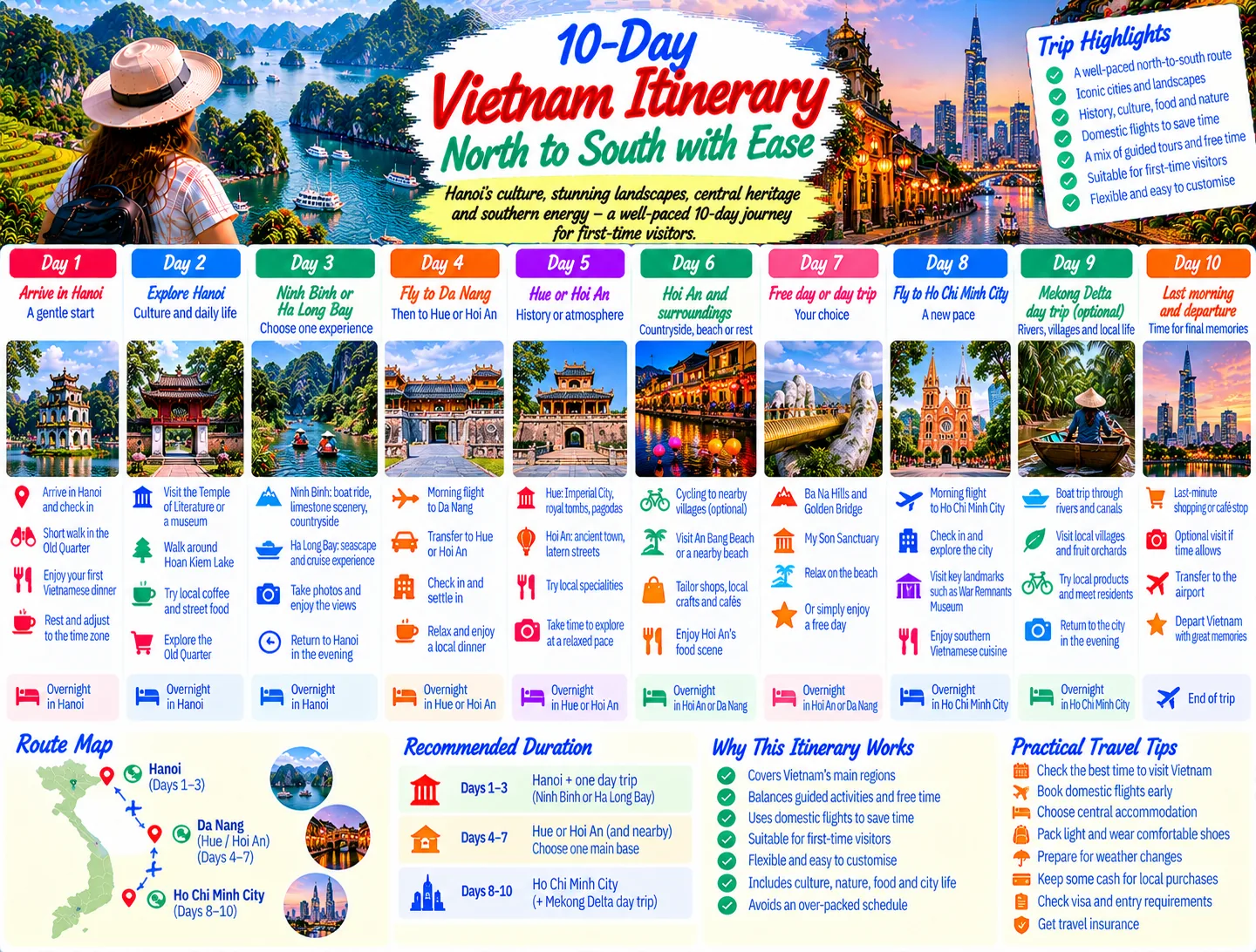
A 10-day Vietnam itinerary can cover the country’s headline experiences without turning every morning into a transfer day. The key is to build a north-to-south route around a few strong bases, then choose one meaningful day trip instead of collecting every possible stop. This plan is designed for first-time visitors who want Hanoi’s street life, limestone scenery, central heritage, and southern energy in one coherent journey.
Vietnam’s official tourism planner describes the country as a mix of islands, highlands, riverfront towns, ancient ruins, rainforests, and urban centres. That variety is exciting, but it also makes overplanning easy. Use this route as a framework, then adjust the balance with the seasonal advice in Best Time to Visit Vietnam and the practical planning notes in A First Vietnam Itinerary with Room to Breathe.
At a glance: the best 10-day Vietnam route
The simplest version is Hanoi, Ninh Binh or Ha Long Bay, Hue or Hoi An, and Ho Chi Minh City. You can include all four regions, but you should not treat every place as an equal-length stay. A workable split is:
Days 1–3: Hanoi, with one northern day trip.
Days 4–5: Central Vietnam, choosing Hue and Hoi An as a paired heritage stop.
Days 6–7: Hoi An and Da Nang, or a slower two-night central base.
Days 8–10: Ho Chi Minh City, with an optional Mekong Delta day trip.
The route works best when you fly between the far north, central Vietnam, and the south, rather than trying to make a long train journey fit every connection. For a fuller comparison of planes, trains, and buses, see How to Travel Around Vietnam: Trains, Flights, Buses and More. The goal is not to see every famous destination; it is to leave each base with enough time for an unhurried meal, a neighbourhood walk, or a change of plan.
Days 1–3: Start in Hanoi and learn the rhythm
Day 1: Old Quarter orientation
Arrive in Hanoi and keep the first day deliberately light. Check in, exchange only the energy you need for the evening, and take a short walk through the Old Quarter. Focus on orientation rather than ticking off monuments: notice how streets cluster around trades, how cafés occupy narrow frontages, and how the pace changes around lakes and public spaces.
For dinner, choose a busy local area and order one or two dishes rather than planning a formal food tour immediately. Jet lag, humidity, and unfamiliar traffic make a gentle first evening more valuable than a late-night itinerary. Keep your next morning flexible in case your arrival is delayed.
Day 2: Hanoi’s culture and everyday city life
Use the second day for a cultural centrepiece and time outdoors. The exact combination can be a museum, a historic quarter, a lake walk, and a café stop. Hanoi rewards short distances linked by curiosity: leave room between major sights so the city itself becomes part of the experience.
Late afternoon is a good time to review the rest of your route. Confirm the name of your next accommodation, check how you will reach the station or airport, and keep digital and paper copies of essential booking details. These small checks reduce friction later, especially when a ten-day trip has several handovers.
Day 3: Choose Ninh Binh or Ha Long Bay
Choose one northern excursion, not both. Ninh Binh is the better fit if you want countryside, karst scenery, and a land-based day with more control over your return. Ha Long Bay is the better fit if a seascape and boat experience are central to your idea of Vietnam. The official tourism authority places Hanoi, Ha Long, and Ninh Binh together within the Red River Delta, a region presented around heritage sites, island landscapes, craft villages, and city nightlife.
Whichever option you choose, protect the evening. A day trip followed by a late transfer and an early flight can make the next two days feel like recovery. If your excursion returns late, move the central flight to the following morning and treat Hanoi as a two-and-a-half-day stop rather than forcing an exact timetable.
Days 4–7: Give central Vietnam the cultural middle
Day 4: Fly to Da Nang, then choose your base
Fly south to Da Nang and decide whether Hue or Hoi An should be your main base. Hue suits travellers who want imperial history, slower riverside evenings, and a more concentrated cultural stay. Hoi An suits travellers who want a walkable old town, food experiences, nearby countryside, and easy access to the coast. Da Nang can work as the practical middle ground if you prefer a modern city, a broad beach, and a convenient airport.
Do not automatically sleep in all three. Every hotel change costs packing time, check-in time, and attention. Pick one base for two nights, then add the other as a day visit only if the journey feels straightforward.
Day 5: Hue for history, or Hoi An for atmosphere
If you base yourself in Hue, give the day to the city’s heritage landscape and allow time for a quiet meal or riverside break. If you base yourself in Hoi An, explore early and late, when walking is more comfortable and the streets feel less compressed by midday activity. The official North Central Coast guide groups Hue and Phong Nha under a region known for caves, beaches, revolutionary history, and agro-ecotourism, so Hue is a natural anchor when you want history with a wider central-Vietnam context.
Travellers who prefer a stronger contrast can spend the morning in Hue and continue to Hoi An later, but make this a deliberate one-way move with luggage arranged in advance. It is less relaxing than a two-night base, yet it can be worthwhile when heritage is your main reason for visiting central Vietnam.
Day 6: Hoi An, Da Nang, or a countryside reset
Use day six to change the texture of the trip. In Hoi An, combine the historic centre with a short countryside or river experience rather than repeating the same walking loop. In Da Nang, pair a beach morning with a city meal or a nearby viewpoint. If you are in Hue, keep the day slower: a second cultural site, a long lunch, and a deliberate evening can be more rewarding than another far-flung excursion.
Build weather flexibility into this part of the itinerary. Central Vietnam can reward a plan that has indoor alternatives, especially when rain or heat changes how long you want to walk. The most useful itinerary is not the one with the most attractions; it is the one that still works when one outdoor plan needs to move.
Day 7: Buffer day before the south
Keep the final central day as a buffer. You can use it for a missed activity, a relaxed beach morning, or a second neighbourhood in your chosen base. Then fly to Ho Chi Minh City in the late afternoon or evening if the connection suits you, or travel the next morning if you value a calmer transition.
This buffer is especially helpful for first-time visitors. A 10-day Vietnam itinerary has enough moving parts that a spare half-day can protect the whole route. If everything goes smoothly, use it for a long breakfast and a final look around rather than adding another destination.
Days 8–10: Finish in Ho Chi Minh City
Day 8: Central districts and the city’s contrasts
Start with a walk through central Ho Chi Minh City, choosing a manageable cluster of landmarks, markets, cafés, or museums. The city is broad and energetic, so plan by neighbourhood rather than by a scattered list. Leave time to sit down: the contrast between colonial-era architecture, high-rise development, dense alleyways, and street-side commerce is easier to appreciate when you are not rushing between pins.
Use the evening for a food-focused route or a relaxed rooftop view. You do not need to reserve every meal in advance; instead, decide what kind of evening you want and keep the final choice close to where you finish sightseeing.
Day 9: Mekong Delta day trip or a deeper city day
On day nine, choose between the Mekong Delta and more time in the city. A Delta excursion makes sense if rivers, rural landscapes, and a change from urban Vietnam are high on your list. Stay in Ho Chi Minh City if you prefer museums, markets, design shops, cafés, or a slower final stretch. A long day trip can be worthwhile, but it should not be treated as compulsory evidence that you have “done” the south.
Ask the operator how much time will be spent on the road, what is included, and how the day handles weather. Keep the wording of the programme in mind: a listed activity is an itinerary promise, not a guarantee that every moment will match a brochure photograph.
Day 10: Flexible finish and departure
Keep your last day simple. If your flight leaves late, revisit a favourite area, buy small gifts, or take a final meal near your accommodation. If you have an early departure, do not schedule a distant attraction. Confirm airport transfer timing with your accommodation and leave a margin for traffic.
How to choose the right version of this route
The classic north-to-south route is not the only sensible answer. Choose a regional version when your priorities are stronger than the urge to cross the whole country:
Heritage-first: Keep Hanoi, Hue, and Hoi An; drop the southern day trip and add a second night where you most enjoy the atmosphere.
Nature-first: Choose Ninh Binh or Ha Long, then keep central Vietnam focused on scenery and coast rather than multiple museums.
Food-and-city-first: Give Hanoi and Ho Chi Minh City more time, using central Vietnam for a compact Hoi An stay.
Lower-stress: Use three bases only and avoid changing hotels on consecutive nights.
For a group, family, or multigenerational trip, reduce the number of early departures. For a solo trip, you may prefer flexible day tours and central accommodation. For budget planning, pair this route with Vietnam Travel Budget and compare the cost of flights, private transfers, and organised day trips before booking.
Transport and booking decisions that protect your time
Book the long north-south and central-south connections first, then fit local experiences around them. Check baggage rules, airport locations, and arrival times before choosing a hotel; a cheap room can be poor value if it creates an expensive or stressful transfer.
Use trains when the journey itself is part of the experience and the route fits your sleep and comfort preferences. Use flights when crossing a large distance would consume a valuable sightseeing day. Use private or shared road transfers when they solve a specific connection, such as linking a day trip with a hotel change. The detailed comparison in How to Travel Around Vietnam: Trains, Flights, Buses and More can help you make that choice without treating one mode as universally best.
Before departure, review the site’s Essential Vietnam Travel Tips and keep a small contingency fund for weather changes, missed connections, or a better last-minute decision. Flexibility is not wasted space in a ten-day plan; it is what keeps the route enjoyable.
Final recommendation: plan the spine, not every minute
This 10-day Vietnam itinerary works because it has a clear spine—Hanoi, central Vietnam, and Ho Chi Minh City—while leaving room to choose Ninh Binh or Ha Long, Hue or Hoi An, and the Mekong Delta or a deeper city day. Book the major transitions, select a few experiences that genuinely matter to you, and let each base provide some unscheduled time. That balance will give you a more memorable trip than a longer list of stops ever could.
JOIN THE CONVERSATION
Comments (0)
No comments yet. Be the first to share a thought.