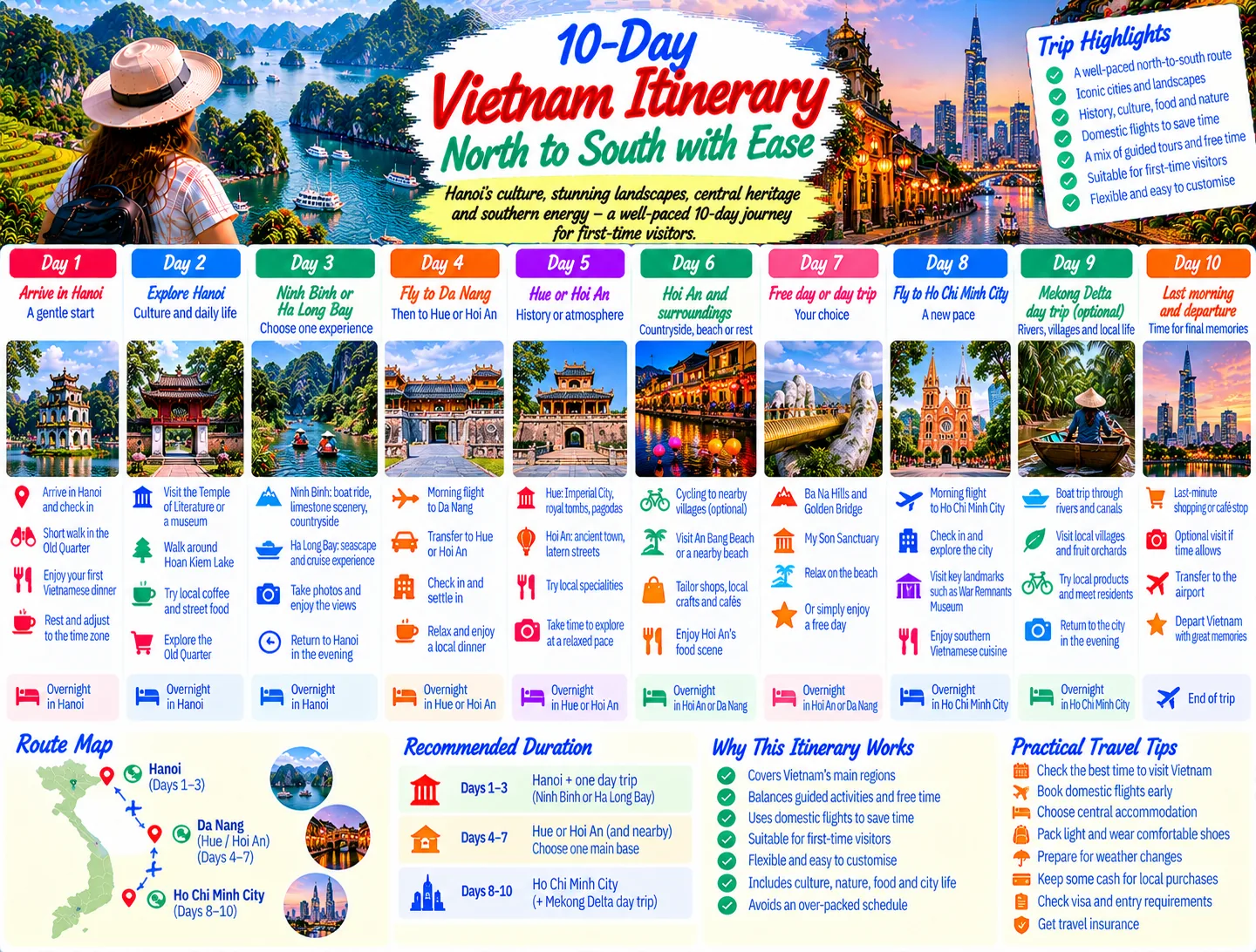
Planning a 14-day Vietnam itinerary is less about collecting every famous stop and more about building a route that changes pace at the right moments. This north-to-south plan combines Hanoi’s food and history, a nature-focused northern escape, imperial Hue, lantern-lit Hoi An, and the energy of Ho Chi Minh City. It is designed for first-time visitors who want variety without turning every day into a transfer day. Use it as a framework, then adjust the number of nights to match your flight schedule, weather preferences, and appetite for early starts.
How this 14-day Vietnam itinerary works
The route moves in one direction: Hanoi, northern mountains, central Vietnam, then Ho Chi Minh City. That shape avoids unnecessary backtracking and gives you a useful balance of cities, landscapes, heritage, and food. Vietnam’s official tourism site describes the country through distinct regions and highlights Hanoi, Hue, Ha Long, Ho Chi Minh City, Da Nang, Hoi An, Sa Pa, and other major destinations. This itinerary deliberately chooses fewer bases so you have time to explore rather than simply photograph a hotel lobby before leaving again.
Allow one flexible day in the plan. Weather, delayed transport, a late arrival, or a place you love can all change your priorities. For entry preparation, keep the practical checklist in this Vietnam visa and entry guide close at hand, and review the Vietnam Travel Itineraries category for alternate route ideas.
Days 1–3: Hanoi for food, history, and orientation
Day 1: Arrive and keep it local
Make your first day intentionally light. Check in, drink water, and explore the streets around the Old Quarter or your chosen neighborhood on foot. A short walk around Hoan Kiem Lake is an easy way to get your bearings, followed by a simple dinner of northern Vietnamese dishes. Do not schedule a long excursion immediately after an overnight flight; the best first impression often comes from noticing small details at street level.
Day 2: Historic Hanoi at a comfortable pace
Start with one major cultural sight, then leave room for wandering. The Temple of Literature, the Ho Chi Minh complex area, the Imperial Citadel, and the Old Quarter each offer a different view of the capital, but trying to cover all of them in a single morning makes the day feel like a checklist. Choose two anchors and connect them with coffee, market browsing, or a slow lunch. In the evening, consider a food walk or a performance if the timing suits you.
Day 3: Choose a second side of the city
Use the third day for a neighborhood or interest that you missed: a museum, craft village, lakeside café, or a longer food-focused route. Hanoi rewards repeat wandering because the atmosphere changes between morning markets, afternoon traffic, and evening dining. If you prefer an organized excursion, keep the schedule modest so you can still prepare for the next morning’s departure.
Days 4–5: A northern landscape escape
For a two-night extension, choose a northern base rather than trying to combine several mountain destinations. Sa Pa is a practical choice for travelers who want dramatic scenery and guided walks; Mai Chau suits a gentler countryside stay; other northern destinations can work if transport connections fit your dates. The official Vietnam Tourism guide describes the Northern Midlands and Mountains as a region of dramatic landscapes, ethnic cultures, community-based tourism, and mountain and lake ecotourism. Let that regional character shape your choice rather than selecting a stop only because it appears in a list.
Day 4: Travel out and settle in
Start early enough to arrive with daylight, but do not pack a full sightseeing program around the transfer. Once checked in, take a short village walk, viewpoint stroll, or local meal. If you book a guided experience, ask what walking surfaces, elevation changes, and weather conditions to expect. A flexible afternoon is valuable in the mountains, where mist or rain can change visibility quickly.
Day 5: Walk, learn, and return at the right time
Spend the day on one well-chosen activity: a guided valley walk, a community-based visit, a market, or a scenic loop. Avoid stacking multiple distant viewpoints. The goal is to experience the landscape, not to prove that you can cross it in one day. Return to your base early enough to rest and confirm the next day’s transport.
Days 6–8: Hue and Hoi An in central Vietnam
Day 6: Move to Hue
Return toward Hanoi or connect through a suitable airport before continuing to Hue, depending on the transport you choose. This is the itinerary’s main transition day, so keep sightseeing limited. Hue is a good place to slow down: riverside walks, garden houses, local dishes, and historic architecture reward an unhurried arrival. If your travel day is long, make dinner the only fixed plan.
Day 7: Give Hue a full cultural day
Use the day for the Imperial City area and one or two additional heritage stops, rather than attempting every tomb and temple. Hue’s appeal comes from the relationship between the former imperial center, the river, gardens, and surrounding landscape. Start early at your main sight, take a substantial midday break, and finish with a calm evening meal. Wear shoes suitable for uneven paths and bring sun protection, especially when moving between open courtyards.
Day 8: Transfer to Hoi An with a planned stop
Travel onward to Hoi An and treat the journey as part of the day. Depending on your chosen route and conditions, you can stop at a viewpoint, beach, or coastal town, but only if the stop does not make the transfer exhausting. After checking in, explore the old streets after the heat softens. Hoi An is most enjoyable when you allow time for an evening walk, a riverside meal, and a second look at details you missed in daylight.
Days 9–10: Hoi An and the central coast
Keep two nights in Hoi An rather than moving hotels every day. Spend one morning in the old town before crowds build, then choose between a cooking experience, a bicycle ride through the countryside, a beach break, or a tailored cultural visit. Cycling can be especially appealing in smaller towns and central Vietnam; the official transport guide notes that Hoi An and Hue are places where bicycles can be practical for reaching many local sights.
On the second day, decide whether you need more activity or more space. A short excursion is enough if you have already had several early starts. If you are traveling with children or a group, use this base for laundry, a slower meal, and a reset. For accommodation planning, compare neighborhood trade-offs in this guide to where to stay in Vietnam and browse the Where to Stay in Vietnam category.
Days 11–13: Ho Chi Minh City and the south
Day 11: Arrive and sample the city
Fly or otherwise connect south, then orient yourself with a short walk around your accommodation area. Ho Chi Minh City is energetic, dense, and best approached in neighborhoods rather than as one giant sightseeing circuit. Choose a market, café district, or central landmark for your first evening. Keep valuables secure, cross streets patiently, and use the safety habits in this practical Vietnam travel safety guide as you settle into the city.
Day 12: History, food, and modern city life
Plan one history-focused visit, one meal-led experience, and time to observe contemporary city life. Museums and historic buildings can be emotionally demanding, so avoid scheduling too many in succession. Balance them with a market, a coffee stop, or a neighborhood walk. Ho Chi Minh City is also a useful place to shop for practical travel items before the final days of your trip.
Day 13: Add a southern contrast
Choose between a nearby day trip and a slower city day. A Mekong Delta excursion can add waterways, gardens, and smaller communities; a city-based day gives you more flexibility if weather or fatigue has accumulated. Be realistic about road time and the quality of the experience you want. A long day is worthwhile only when the destination, guide, and pace match your interests.
Day 14: Departure day and useful buffer time
Keep the final day deliberately simple. Confirm your airport transfer, check documents, and leave enough time for traffic and check-in. If your flight departs late, choose an activity close to your accommodation rather than crossing the city for one last attraction. Travelers with an open-jaw ticket can use this day for a final meal or a short neighborhood walk. Travelers returning from the same airport should treat the buffer as part of the itinerary, not as wasted time.
How to choose transport between stops
Transport decisions determine whether a 14-day Vietnam itinerary feels spacious or rushed. Vietnam Tourism explains that domestic flights are often the convenient option across long distances, while trains and buses make sense when you want an overland experience or a shorter regional connection. The same guide notes that train journeys can be slow and that road distances are easy to underestimate. In practice:
- Use a flight for the long north-to-central or central-to-south jumps when time matters.
- Use trains when the route, departure time, and scenery justify a slower journey.
- Use local transfers for the final leg to a hotel, village, beach, or trailhead.
- Leave recovery time after overnight travel instead of planning a demanding tour on arrival.
For broader planning, compare this site’s guide to trains, flights, buses, and other transport with the Transportation in Vietnam category. Check current schedules and booking conditions close to departure because services, routes, and operating details can change.
How to adapt the route for your travel style
If you want fewer hotel changes
Drop the northern mountain escape and add one more night to Hanoi, Hue, Hoi An, or Ho Chi Minh City. This creates a calmer route and works well for first-time visitors who prefer independent days.
If you want more nature
Keep the northern escape, protect the two Hoi An nights, and reduce the number of urban sights rather than adding another distant destination. Nature days need weather flexibility and recovery time.
If you are traveling on a tighter budget
Use the itinerary’s structure but compare flights, trains, and buses for each long leg. Choose one or two paid signature experiences and spend the remaining time on markets, walks, public spaces, and self-guided neighborhood exploration. The site’s flexible Vietnam travel budget guide can help you separate fixed costs from daily choices.
Final planning checklist
- Choose a north-to-south direction unless your flights make another route clearly better.
- Book the long transfer legs first, then shape day tours around them.
- Keep at least one afternoon with no fixed appointment every few days.
- Check seasonal conditions for mountain walks, coastal activities, and heavy-rain periods.
- Confirm entry documents, luggage rules, pickup points, and cancellation terms before paying.
- Save offline hotel addresses and a simple version of the route for arrival days.
A good 14-day Vietnam itinerary should feel varied but not frantic. Give each region enough time to reveal its character, choose transport according to the distance, and leave room for meals, weather, and the unexpected discoveries that make a long trip memorable.
JOIN THE CONVERSATION
Comments (0)
No comments yet. Be the first to share a thought.