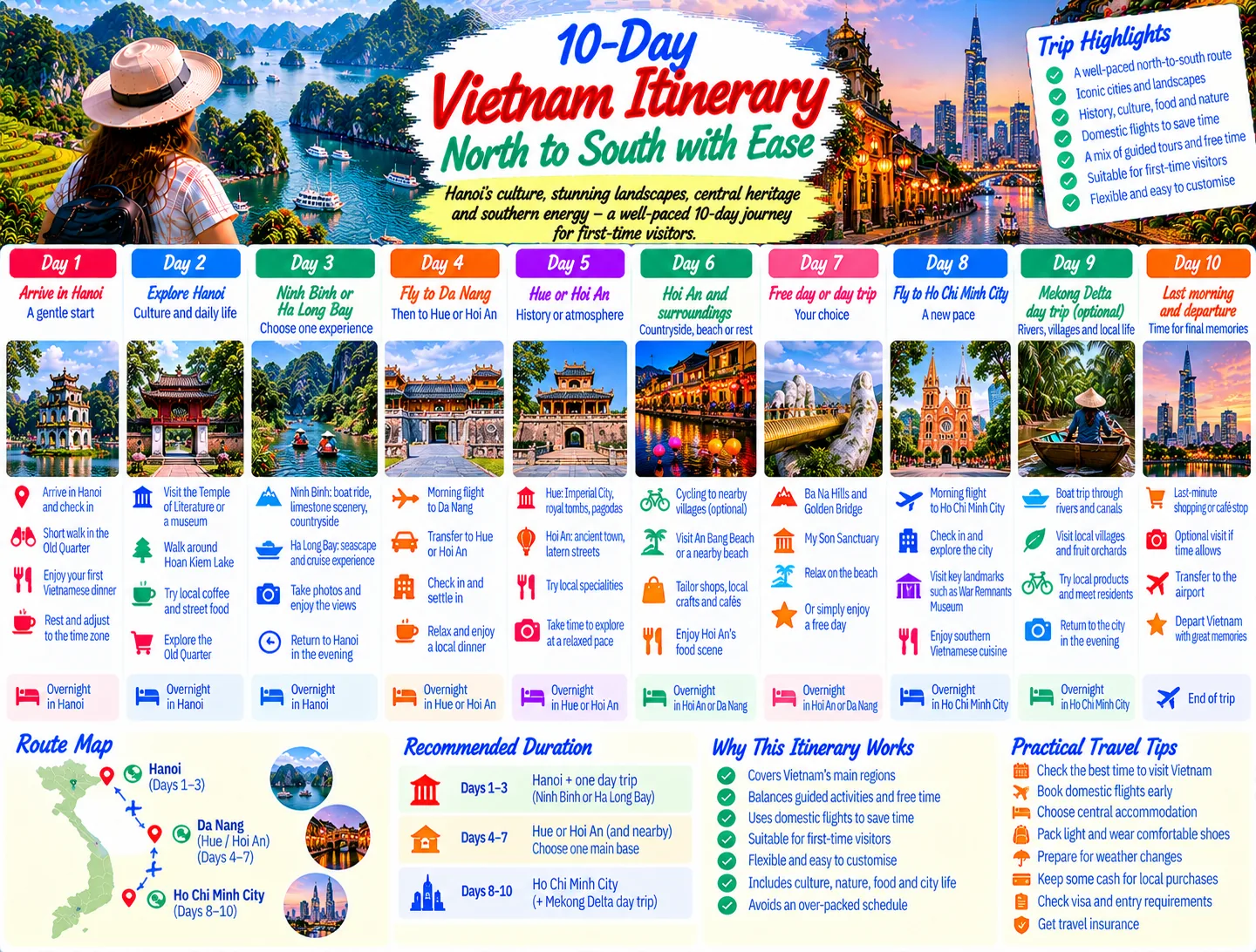
A seven-day Vietnam itinerary works best when it treats the country as a highlight reel rather than a race from one end to the other. This route links Hanoi, Da Nang and Hoi An, then finishes in Ho Chi Minh City, giving first-time visitors a balanced introduction to northern history, central-coast scenery, lantern-lit old streets and southern city energy. It is a practical Vietnam itinerary for travelers who want memorable places without spending every day in transit.
How this 7-day Vietnam itinerary works
The route uses three bases: Hanoi for the north, Da Nang or Hoi An for central Vietnam, and Ho Chi Minh City for the south. You will need two domestic flights to make the schedule comfortable. That is not a weakness; Vietnam is long and narrow, and sensible routing protects your sightseeing time. For a slower trip, remove Ho Chi Minh City and add nights around central Vietnam. For more northern scenery, replace the southern finish with Ninh Binh or Ha Long Bay.
This plan assumes you arrive in Hanoi before Day 1 and fly home from Ho Chi Minh City after Day 7. If your return flight leaves from Hanoi, reverse the order or book an open-jaw ticket. Before fixing dates, compare seasonal conditions by region in the best time to visit Vietnam guide, because one national forecast can hide very different weather along the coast and in the south.
Days 1–2: Discover Hanoi’s historic core
Day 1: Old Quarter, Hoan Kiem Lake and street food
Keep your first day compact. Start around Hoan Kiem Lake, then cross into the Old Quarter while the streets are lively. The official Vietnam Tourism guide describes Hanoi as a capital shaped by long history, lakes, old architecture and street food; those contrasts are exactly what make it a strong opening city. Walk without trying to collect every landmark. Notice the narrow tube houses, small temples, shopfronts and changing food stalls.
In the afternoon, choose one cultural stop rather than packing in several. The Temple of Literature suits travelers interested in scholarship and traditional architecture, while the Imperial Citadel of Thang Long adds royal history and archaeological context. If you prefer a lighter day after a long flight, stay around the lake and Old Quarter, then take a short evening walk.
Make dinner part of the itinerary. Try Hanoi specialties such as pho, bun cha, banh mi or egg coffee, but choose places with a busy local turnover and order modestly if your stomach is adjusting. The point is not to turn dinner into a checklist; it is to understand how the city’s everyday food culture fits into its streets.
Day 2: Choose one Hanoi theme
Use your second morning for a focused theme. History-minded travelers can visit the Ho Chi Minh Mausoleum area and the nearby museums or monuments that are open on their chosen date. Culture seekers can pair the Temple of Literature with a water-puppet performance. Food-focused travelers can spend the morning moving between markets, cafés and neighborhood breakfast spots.
Leave the afternoon flexible. Hanoi rewards unplanned time: a quiet lakeside break, a coffee in a restored building or a final walk through the Old Quarter may be more satisfying than another distant attraction. If you have a late flight on Day 2, stay near the center and allow generous transfer time. For practical planning before departure, review these essential Vietnam travel tips, especially the advice on pacing, payments and arrival routines.
Day 3: Fly to Da Nang and settle into central Vietnam
Take a morning flight from Hanoi to Da Nang, then choose your base according to your priorities. Da Nang is convenient for beaches, city restaurants, the airport and onward transport. Hoi An is better if your priority is an atmospheric old town and slower evenings. Either works, but avoid changing hotels on the same day as your flight.
Da Nang’s official tourism guide highlights broad beaches, street food, the Son Tra Peninsula, Marble Mountains and the Hai Van Pass. Use that combination to design a gentle arrival day: check in, walk beside the sea or explore a nearby market, and save a major excursion for tomorrow. If you stay in Hoi An, spend the evening walking the historic center after settling in, without planning a long list of stops.
For transport choices between airports, cities and attractions, use the site’s Vietnam transport guide alongside current airline or operator information. Journey times and schedules change, so treat any itinerary as a framework and recheck the details before booking.
Day 4: Choose Da Nang scenery or a Hoi An culture day
Option A: Da Nang and the coast
Begin with My Khe Beach or another accessible stretch of coast, then continue to the Marble Mountains if you want caves, pagodas and viewpoints. Wear shoes suitable for steps and allow time to move slowly through the site. In the afternoon, choose either a relaxed café-and-food route in Da Nang or a coastal drive toward Son Tra Peninsula. Do not force every stop into one day; heat, traffic and stairs can make a short list feel full.
Option B: Hoi An and the old town
Spend the morning exploring Hoi An’s lanes, assembly halls, riverside streets and independent shops. Use the middle of the day for lunch and a rest, then return later when the light softens. Hoi An is most enjoyable when you leave room for details: doorways, courtyards, small workshops and local dishes rather than only the busiest photo points.
If your interests include a scenic road journey, the Hai Van Pass can connect the Da Nang and Hue area, but it is not a sensible add-on when you must also fit a full Hoi An day. Pick one central-Vietnam experience and do it well. Travelers who need a room strategy can compare neighborhoods in the Vietnam accommodation guide before choosing between Da Nang and Hoi An.
Day 5: Fly south and read Ho Chi Minh City at street level
Fly from Da Nang to Ho Chi Minh City, preferably early enough to leave part of the afternoon free. The city is a sharp contrast to Hanoi: busier, more tropical and strongly shaped by commercial energy. Vietnam Tourism describes it as the economic heart and main hub of the southern region, with landmarks, markets and neighborhoods that bring old and new city life together.
Start with a walk through the central districts. A compact route can include the Central Post Office area, the Saigon Opera House surroundings and Ben Thanh Market, depending on your energy and opening conditions. Rather than crossing the whole city, choose a small cluster and observe how traffic, cafés, sidewalk vendors and colonial-era buildings share the same space.
For dinner, explore southern flavors such as banh xeo, com tam or a banh mi variation. The official city guide also points visitors toward Cho Lon, the city’s Chinese quarter, but save that neighborhood for Day 6 unless it is your main interest. Check current local conditions and use a reputable ride-hailing or taxi option for longer transfers; never assume a map’s travel time will match rush-hour reality.
Day 6: Build a focused Ho Chi Minh City day
History and landmarks
Choose a morning of museums and historic buildings, then keep the afternoon close to your hotel. The War Remnants Museum and central landmarks are common choices, but check current opening arrangements before committing. A slower plan is often better: one substantial museum, a meal and a neighborhood walk will give you more context than several rushed interiors.
Markets, Cholon or local food
If you prefer urban texture, head toward Cho Lon and explore around Binh Tay Market and Thien Hau Pagoda. The city tourism guide identifies this Chinese quarter as a worthwhile walking area. Go with respectful clothing for religious sites, follow signs and local instructions, and keep valuables secure in crowded streets.
Food travelers can instead spend the day on a carefully chosen eating route. Leave gaps between meals, carry water and be cautious with unfamiliar ingredients if you have allergies. For budgeting decisions across the whole journey, connect this plan with the Vietnam travel budget category; the right number depends more on room style, flights, tours and dining choices than on a single daily average.
Day 7: Finish with a realistic final morning
Do not schedule a distant day trip on the final day unless your flight is late and your luggage plan is secure. Instead, revisit a favorite neighborhood, buy small gifts, enjoy one final coffee or take a short market walk. If you want a nearby southern experience, plan it only after checking traffic, weather, transport and airport requirements.
Keep your final hours practical. Confirm your airport transfer, allow extra time for congestion and keep passports, phones, medication and valuables in your hand luggage. If your international flight departs late, you can extend your city walk; if it leaves in the afternoon, finish sightseeing near your accommodation and leave earlier than feels necessary.
How to customize the route without breaking it
- For a slower trip: remove Ho Chi Minh City and add two nights to Hanoi, Da Nang or Hoi An.
- For more nature: replace one city day with a properly researched northern or central excursion, not several long transfers.
- For families: keep one major activity per day, schedule midday rest and choose hotels with simple access.
- For food lovers: protect meal times and neighborhoods rather than adding more destinations.
- For a tighter budget: compare flight timing, hotel location and luggage rules before selecting the cheapest headline fare.
Whichever version you choose, leave buffer time around flights and do not treat online schedules as permanent. The best Vietnam itinerary is specific enough to guide you and flexible enough to survive weather, traffic, tiredness and an unexpectedly good meal.
Final planning checklist
Before booking, confirm your entry documents and permitted stay, then check the latest airline baggage rules. Reserve the first Hanoi night and the final Ho Chi Minh City night before arrival, and choose central accommodation that reduces daily transfers. Recheck domestic flight times, airport transfer plans and attraction arrangements shortly before each travel day. If you are still deciding how much structure you need, compare this route with the site’s flexible first Vietnam itinerary and keep the version that matches your pace.
Conclusion
This seven-day Vietnam itinerary is designed as a connected introduction, not a complete survey of the country. Hanoi supplies history and street life, Da Nang or Hoi An adds central-coast character, and Ho Chi Minh City closes the trip with southern energy and food. Book the long moves carefully, keep each day focused and leave enough unplanned time to notice the places between the headline sights.
JOIN THE CONVERSATION
Comments (0)
No comments yet. Be the first to share a thought.