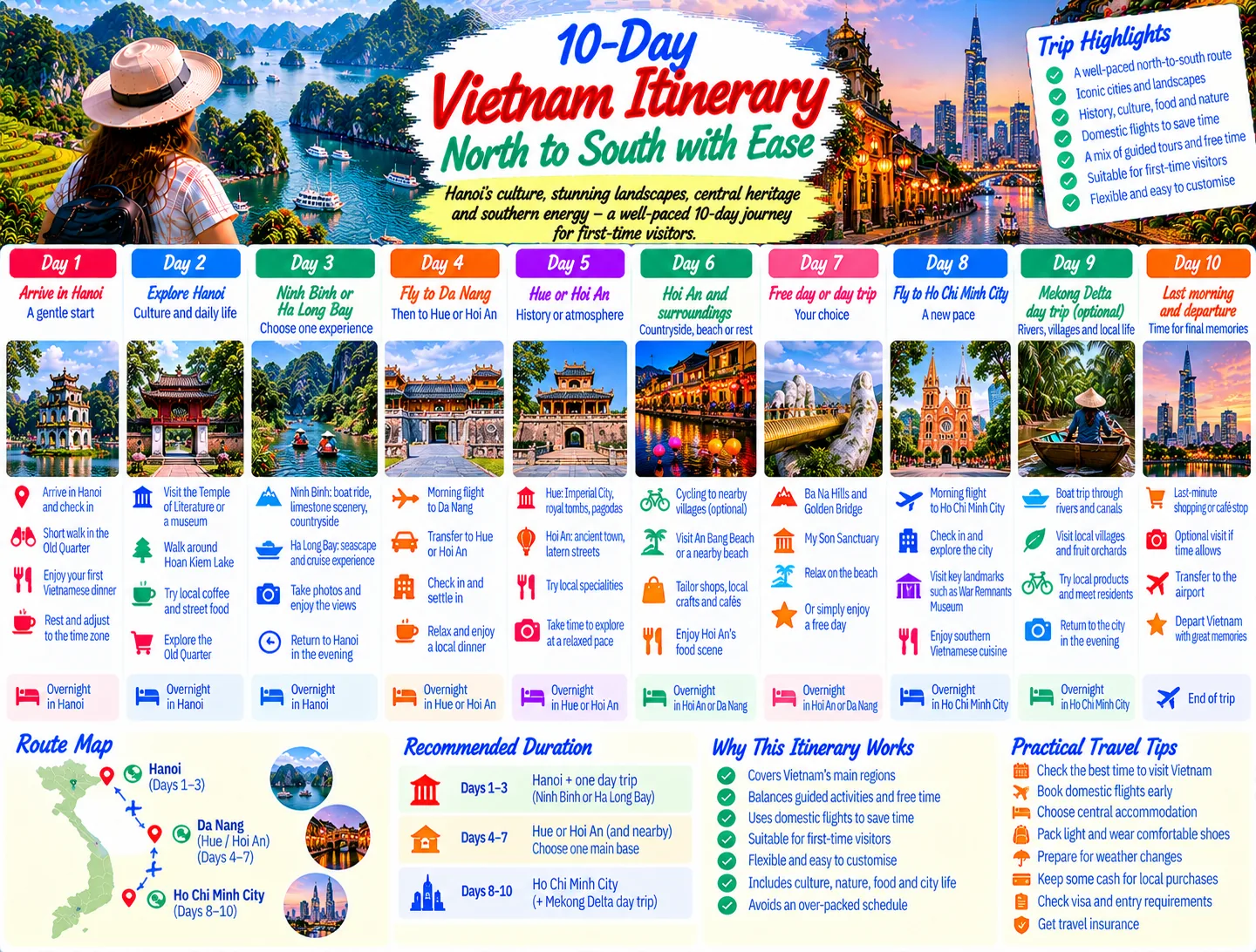
A well-paced 14-day Vietnam itinerary can show you the country’s biggest contrasts without turning every morning into a checkout day. This north-to-south route starts in Hanoi, adds the limestone scenery of Ninh Binh, moves through imperial Hue and the beaches and food of Da Nang and Hoi An, then finishes in energetic Ho Chi Minh City. It is designed for first-time visitors who want a clear structure but still enough flexibility for weather, rest and spontaneous meals.
How this 14-day Vietnam itinerary works
The route follows Vietnam’s geography, so you avoid repeatedly backtracking. The north gives you historic streets and karst landscapes, central Vietnam adds royal heritage and coastal scenery, and the south ends with museums, markets and urban energy. The plan uses a mix of flights, trains and short road transfers rather than insisting on one transport mode for the whole country.
Think of the schedule as a framework, not a compulsory checklist. If you prefer a slower trip, remove one central stop. If landscapes matter more than cities, exchange the extra Hanoi day for a mountain or bay excursion. Before fixing dates, compare regional weather because Vietnam can be sunny in one part of the country while wet elsewhere. The site’s best time to visit Vietnam guide is useful for making that decision.
Days 1–3: Hanoi, the best starting point
Day 1: Arrive and settle into the Old Quarter
Keep your first day intentionally light. Check in, walk through the Old Quarter, and use the evening to learn the rhythm of crossing streets, ordering food and navigating small lanes. Hoan Kiem Lake makes an easy orientation walk, while a food-focused dinner gives you an immediate introduction to northern Vietnamese flavours.
Do not schedule a distant day trip on arrival day. Delays, jet lag and the simple effort of getting cash, a local data connection or transport sorted can take longer than expected. A flexible first afternoon is part of a good itinerary, not wasted time.
Day 2: Hanoi’s history, food and neighbourhoods
Choose two or three anchor experiences rather than trying to see every museum. You might combine a historic site with the Temple of Literature, spend time around the French Quarter, and leave space for a long lunch or coffee stop. Hanoi rewards wandering, so build the day around neighbourhoods instead of zigzagging across the city.
In the evening, book a street-food walk or make your own tasting route. Keep your schedule open enough to return to a favourite café, market or lake view. The practical suggestions in Vietnam for First-Time Visitors: Start with the Basics can help you prepare for the city’s busy streets and local customs.
Day 3: Choose city depth or a northern add-on
Use the third day in one of two ways. Stay in Hanoi if you enjoy food, architecture and museums, or choose a carefully planned northern excursion if you want more scenery. A remote mountain loop is not a casual add-on: it needs several days and longer road travel, so it should replace part of this route rather than be squeezed between city stops.
For most first-time travellers, another Hanoi day creates a calmer trip. Visit a market early, take a cooking class, or simply leave a half-day unplanned. You will appreciate that breathing room later.
Days 4–5: Ninh Binh’s karst landscape
Day 4: Transfer from Hanoi and explore by water
Move to Ninh Binh and use the afternoon for a sampan trip in the Trang An or Tam Coc area. Vietnam’s official tourism site describes Ninh Binh as a riverine landscape of limestone mountains and recommends boat trips as one of the best ways to understand it. The area is also reachable from Hanoi by train or road, making it a natural two-night break between the capital and central Vietnam.
Stay near the countryside if you want quiet mornings, or near the main town if you value easier restaurant access. Whichever base you choose, allow extra time for roads between attractions. Ninh Binh looks compact on a map, but the experience is best when you are not rushing from one viewpoint to the next.
Day 5: Viewpoints, temples and rural roads
Start early for a panoramic viewpoint such as Hang Mua, then choose one cultural stop and one gentle countryside activity. The official destination guide notes that Hang Mua’s viewpoint involves a substantial stair climb, so treat it as an active outing rather than a casual photo stop. If heat or mobility is a concern, prioritise the boat ride and a slower village route instead.
Ninh Binh is where this itinerary changes pace. Pack a day bag, keep the phone away for part of the morning, and let the scenery do the work. For broader planning help, compare your transport options with How to Travel Around Vietnam: Trains, Flights, Buses and More.
Days 6–8: Hue and the central coast
Day 6: Travel to Hue
Use a flight or a longer rail journey to reach central Vietnam, depending on whether the journey itself is part of your holiday. Once in Hue, take a gentle walk beside the Perfume River and have a relaxed dinner. Hue is a good place to slow down after two active days in Ninh Binh.
Keep the first evening free because arrival logistics can be unpredictable. If you arrive early, add a market visit or a short riverside cycle; if you arrive late, you have lost nothing important.
Day 7: Imperial Hue
Give Hue a full day for its imperial heritage. Visit the Citadel, then choose one or two royal tombs rather than attempting every site. Vietnam Tourism describes Hue as a former Nguyen Dynasty capital shaped by the Perfume River, with a food culture and pagodas that deserve attention alongside the monuments.
Balance history with a meal built around local specialities. Hue’s atmosphere is more measured than Hanoi’s, and the city makes sense when you combine architecture, river scenery and food instead of treating it as a single monument stop.
Day 8: Hue to Da Nang and Hoi An
Move south along the coast by road or train and base yourself in either Da Nang or Hoi An. Da Nang is convenient for beaches, airport access and a larger range of accommodation. Hoi An is better if your priority is atmospheric evenings and a compact historic centre. You can visit both, but changing hotels again is not necessary.
On the transfer day, choose one meaningful stop or scenic detour, not a packed list. The official Da Nang guide highlights My Khe Beach, the Marble Mountains and the Son Tra Peninsula, while its regional position also makes it a practical gateway to central Vietnam’s coast.
Days 9–10: Hoi An and the coast
Day 9: Hoi An at an easy pace
Explore Hoi An’s historic streets in the morning, when the atmosphere is quieter, then use the afternoon for a cooking class, tailor appointment, café break or cycle through the surrounding countryside. Leave room for dinner and an evening walk rather than scheduling another long excursion.
Hoi An works best when you resist the urge to measure the day by attractions. The point is to notice the architecture, food and transition from busy daytime lanes to a softer evening mood. If you are travelling with children or a group, this is also a useful recovery day.
Day 10: Beach, countryside or Marble Mountains
Choose one final central-Vietnam experience. Beach time suits a warm, clear day; a countryside ride gives you a slower look at the region; and the Marble Mountains provide caves, pagodas and viewpoints close to Da Nang. Confirm local conditions before committing to outdoor plans, especially during periods of heavy rain.
Fly south from Da Nang when possible, or leave the next morning if that produces a better fare or a less stressful connection. The goal is to protect your final days rather than win a small scheduling advantage.
Days 11–14: Ho Chi Minh City and a flexible finish
Day 11: Arrive and get oriented
Use your first Ho Chi Minh City day for a neighbourhood walk and an easy meal. The city is dense, fast-moving and full of competing sounds, so a short orientation helps you choose what deserves a deeper visit. District 1 is convenient for many first-time landmarks, but do not assume it represents the whole city.
Day 12: History, architecture and markets
Build a walking route around the city’s historic core. Vietnam Tourism highlights the War Museum, Central Post Office, Notre Dame Cathedral Basilica, Saigon Opera House and Ben Thanh Market among the city’s well-known sights. Check the current status of individual venues before you go, then choose a manageable cluster rather than crossing town repeatedly.
Use the afternoon for a café, a small gallery or a food tour. Ho Chi Minh City is more enjoyable when you alternate major sights with ordinary street life.
Day 13: Choose a southern day trip or city depth
If you want a final excursion, choose a reputable day trip and read the itinerary carefully before booking. Otherwise, stay in the city and explore Cholon, local markets or a different district. A second urban day is often the better choice for travellers who dislike long transfers at the end of a trip.
Keep your final evening practical: confirm airport transport, check baggage, and leave a buffer for traffic. The essential Vietnam travel tips category is a useful pre-departure checklist, while the Vietnam travel safety guide can help you review everyday precautions.
Day 14: Depart or add the Mekong Delta
For a later flight, enjoy a final breakfast and keep your plans close to the hotel. If your schedule allows an additional night, the Mekong Delta can replace one of the Ho Chi Minh City days, but it is better treated as a deliberate extension than a rushed side trip. Can Tho, for example, is known for waterways, fruit-growing areas and early-morning floating-market experiences according to Vietnam Tourism.
How to adjust the route for your travel style
- For slower travel: remove either Hue or Ninh Binh and add two nights to the destinations you keep.
- For scenery: replace the third Hanoi day with a multi-day northern mountain trip, not a rushed overnight.
- For beaches: add a night around Da Nang and reduce city sightseeing in Ho Chi Minh City.
- For food: protect meal times in Hanoi, Hue, Hoi An and Ho Chi Minh City instead of booking continuous tours.
- For budget control: compare the total cost of flights, baggage, station transfers and extra hotel nights; the Vietnam travel budget category can help structure the comparison.
Final planning checks before booking
Book the long domestic movements first, then arrange accommodation around the route. Keep at least one flexible block in each major region. Check weather by region rather than relying on one national forecast, and confirm venue hours, transport departures and ticket rules close to travel. Carry a small day bag for transfers, keep digital and paper copies of important documents, and avoid making the final day dependent on a long cross-country journey.
This 14-day Vietnam itinerary works because it combines headline destinations with recovery time. Start with Hanoi’s intensity, slow down in Ninh Binh, absorb Hue’s history, enjoy the central coast, and finish in Ho Chi Minh City with enough flexibility to follow your own interests. The best version is not the one with the most stops; it is the one you can actually enjoy.
JOIN THE CONVERSATION
Comments (0)
No comments yet. Be the first to share a thought.