A Vietnam itinerary works best when it follows the country’s north-to-south geography without trying to collect every famous stop. With 12 days, you can combine Hanoi’s historic lanes, the limestone landscapes around Ninh Binh, imperial Hue, lantern-lit Hoi An, and energetic Ho Chi Minh City. The key is to give each region enough time, use one or two longer travel days deliberately, and leave space for weather or a slower morning.
How to shape a 12-day Vietnam itinerary
This route is designed for a first substantial trip rather than a rushed checklist. It uses five bases: Hanoi, Ninh Binh, Hue, Hoi An, and Ho Chi Minh City. Shorten it by removing one night in Ninh Binh and one in Hoi An, or extend it with Ha Long Bay, Phong Nha, or the Mekong Delta.
North-to-south routing usually feels natural because Hanoi is a strong cultural starting point and Ho Chi Minh City is a practical southern finish. Vietnam Tourism describes Hanoi as a gateway to northern Vietnam and highlights its Old Quarter, lakes, food culture, and layered history. In the south, the official tourism guide presents Ho Chi Minh City as the region’s main urban hub, with major museums, markets, colonial-era landmarks, and lively street food.
Before booking, compare this plan with our flexible first Vietnam itinerary if you prefer fewer hotel changes. For transport decisions, the guide to trains, flights, buses and more in Vietnam explains how to match each journey to your time and comfort level.
Days 1–3: Begin in Hanoi
Day 1: Settle into the Old Quarter
Keep your first day intentionally light. After arriving, check in, drink water, and explore the area around Hoan Kiem Lake at an easy pace. The Old Quarter is best experienced on foot in short loops: one street for architecture, one café stop, a market detour, and an early dinner. If you arrive late or tired, a meal and a quiet walk are enough.
Hanoi rewards curiosity more than rigid scheduling. Try a local breakfast or noodle dish, observe how the streets change from morning to evening, and save major museums for a day when you have more energy. When crossing busy roads, move steadily and predictably rather than stepping back and forth.
Day 2: History, food, and a slower city rhythm
Use the morning for the Temple of Literature or the Imperial Citadel of Thang Long, then pause during the warmest part of the day. In the afternoon, choose one focused theme: Vietnamese history, contemporary cafés, craft streets, or a guided food walk. Hanoi’s official destination guide identifies Hoan Kiem Lake, the Old Quarter, the Temple of Literature, the Ho Chi Minh Mausoleum Complex, and the Imperial Citadel among the city’s key sights, so you do not need to force them all into one day.
Evenings are ideal for a water-puppet performance, a casual street-food crawl, or simply returning to a favorite neighborhood. If you want seasonal planning help, see our region-by-region guide to the best time to visit Vietnam; the north, central coast, and south can feel very different on the same trip.
Day 3: Add one Hanoi experience
Choose one half-day experience instead of adding another long transfer. You could revisit the Old Quarter early, visit a museum, take a cooking class, or explore a quieter lakeside area. If your flight or train to Ninh Binh is later, keep your luggage easy to handle and avoid booking a tightly timed final activity.
Days 4–5: Trade the capital for Ninh Binh
Day 4: Move south and explore the karst landscape
Ninh Binh makes a useful contrast with Hanoi: the city noise falls away, and the itinerary becomes more landscape-focused. Travel there in the morning, leave your bags, and plan one main outing. A boat trip through limestone scenery is the classic choice, but the best experience comes from treating it as a half-day rhythm rather than racing between several sites.
Spend the rest of the day near your base, especially if you are staying outside central Ninh Binh. Rural roads, rice fields, temples, and small cafés are easier to enjoy when you are not watching the clock. Ask your accommodation about current access conditions and weather before setting off, particularly during heavy rain.
Day 5: Choose between viewpoints and a quiet countryside day
Start early for a viewpoint or temple area, then return for a relaxed lunch. The region is a good place to use a bicycle or short local ride if conditions are comfortable, but do not turn every distance into a self-guided challenge with luggage or poor weather. Keep the afternoon flexible so you can repeat a favorite landscape, rest, or prepare for the next travel leg.
Ninh Binh is also where a budget becomes easier to control: one base, simple meals, and fewer paid attractions can balance more expensive city stays. For broader planning, browse the Vietnam travel budget category before finalizing hotels and transfers.
Days 6–7: Make Hue your cultural pause
Day 6: Travel to Hue and settle beside the Perfume River
Plan the Ninh Binh-to-Hue journey as a major travel day. Depending on your schedule and preferred comfort, compare a flight connection with an overnight or daytime rail option. The right choice is the one that protects your sightseeing time without leaving you exhausted. Avoid promising yourself a full attraction day immediately after a long transfer.
Hue’s official tourism page describes the city as the former Nguyen Dynasty capital, shaped by the Perfume River, royal architecture, pagodas, markets, and refined local food. That gives Hue a different role from Hanoi: do not treat it as another walking-city checklist. Use the first evening for a riverside stroll and a simple meal.
Day 7: Imperial history and local food
Give the Imperial City the morning, when you can take in courtyards and gates without compressing the visit. In the afternoon, choose one or two tombs or a pagoda rather than attempting every royal site. Hue’s official guide specifically recommends making time for the Citadel and the tombs of emperors Tu Duc, Minh Mang, and Khai Dinh, while also highlighting Thien Mu Pagoda and the countryside around Thanh Toan Bridge.
Food is part of the itinerary, not an afterthought. Look for regional dishes such as banh beo or banh khoai, and ask a local host which specialties are available that day. Keep your evening unhurried; Hue is often most memorable when you leave room for a quiet café or river walk.
Days 8–9: Continue to Hoi An through the central coast
Day 8: Make the journey part of the plan
Travel from Hue toward Hoi An with a stop or scenic route if the weather is clear and the timing works. The central coast is better handled as a transition day than as a race to arrive early and then squeeze in several distant sights. Confirm the exact route, luggage arrangements, and drop-off point with your provider before departure, because road conditions and service patterns can change.
After checking in, explore Hoi An’s old center in the late afternoon and evening. Focus on orientation: identify the river, your walking route back to the hotel, a breakfast place, and a restaurant that can accommodate your needs. Leave photography, shopping, and lantern-lit streets as optional pleasures rather than obligations.
Day 9: Pick a Hoi An theme
Choose one main experience and let the rest of the day breathe. Options include a market and cooking-focused morning, a bicycle ride into the countryside, a beach break, a craft or tailoring appointment, or a second slow circuit of the old town. If you add a nearby excursion, check return times carefully so you are not relying on a last-minute transfer for an onward flight.
Hoi An is a good place to slow the itinerary after several cultural sites. Two nights are enough for a taste; three nights are better if you want beach time or a planned activity. Travelers who prefer a gentler pace can remove Ninh Binh and give those nights to Hoi An instead.
Days 10–12: Finish in Ho Chi Minh City
Day 10: Arrive and learn the city’s shape
Fly from the central coast to Ho Chi Minh City, then use your first afternoon to understand the central districts on foot or with a short ride. The official tourism guide points visitors toward the Central Post Office, Notre Dame Cathedral Basilica, Saigon Opera House, Ben Thanh Market, Jade Emperor Pagoda, and the Chinese quarter of Cho Lon.
Do not book a major day trip immediately after arrival. Instead, choose one compact cluster of landmarks and finish with dinner. Ho Chi Minh City is energetic and sprawling, so a short list produces a better first impression than trying to cover every district.
Day 11: Museums, markets, and street-level life
Build the day around your interests. History-focused travelers can choose a museum and a central landmark; food-focused travelers can explore a market, a café neighborhood, and southern dishes such as banh xeo or com tam. The official city guide also highlights Cholon, Binh Tay Market, and Thien Hau Pagoda for a different perspective on the metropolis.
Use a ride-hailing or taxi option you are comfortable with, keep your phone secure near traffic, and allow extra time for crossings and congestion. For practical movement choices, consult the Transportation in Vietnam category before choosing airport transfers or day tours.
Day 12: Leave a buffer before departure
Keep your final morning deliberately close to your accommodation. Buy small food gifts, revisit a café, or take one short walk rather than scheduling a distant attraction. If your departure is later, confirm baggage storage and airport timing with your hotel. A buffer is especially valuable on a multi-city route because the trip has already included several flights or long transfers.
How to adjust this route for different travelers
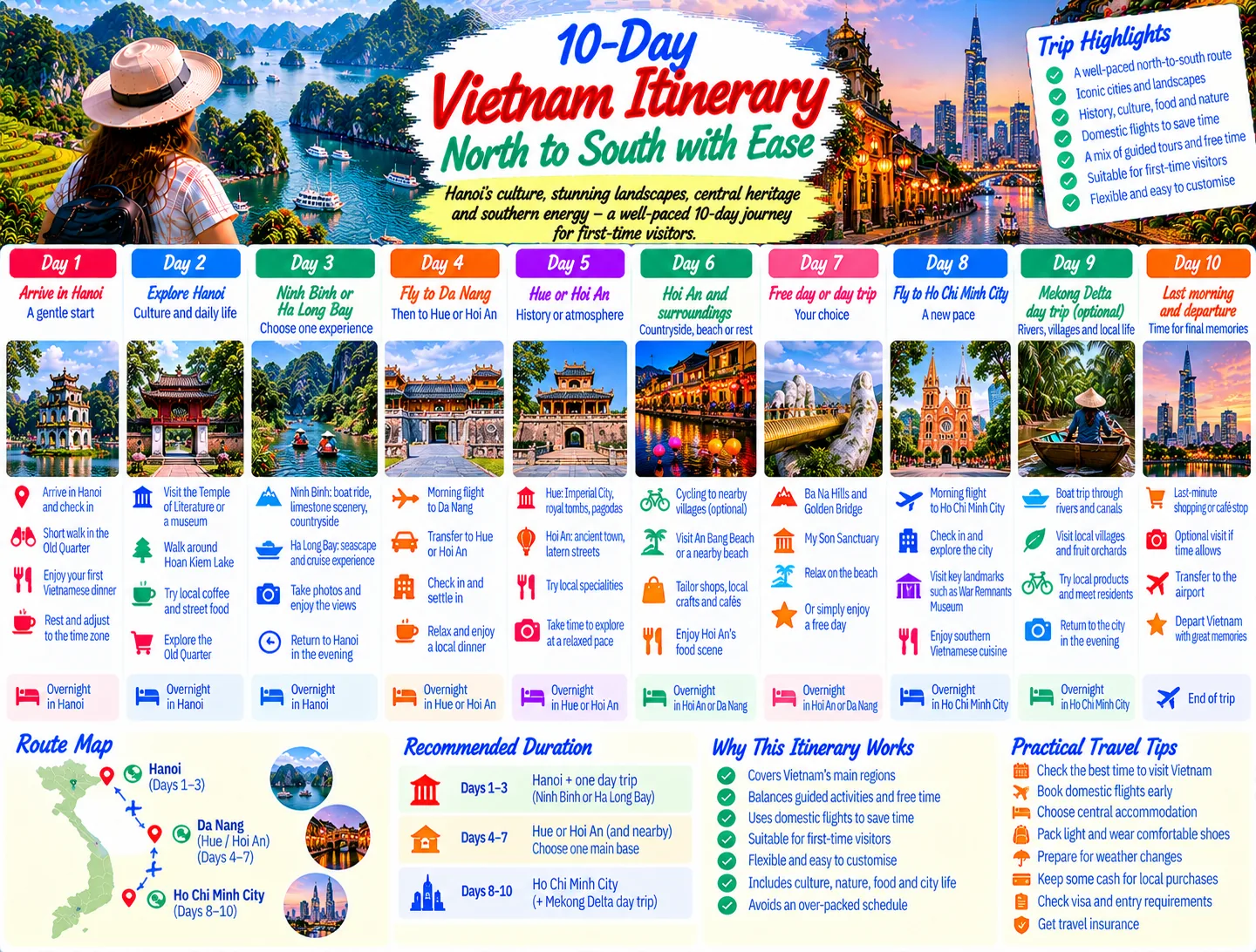
- For a faster 10-day trip: stay two nights in Hanoi, one in Ninh Binh, two in Hue, two in Hoi An, and two in Ho Chi Minh City, keeping one final buffer night where possible.
- For a two-week trip: add Ha Long Bay after Hanoi, Phong Nha between Hue and Hoi An, or the Mekong Delta after Ho Chi Minh City. Add only one extension unless you are comfortable with another travel day.
- For families: reduce hotel changes, protect midday rest, and choose one anchor activity per day. The Family & Group Travel category has more ideas for balancing different ages.
- For shoulder-season travel: keep alternatives ready. A rainy central-coast day may favor museums, food, or a flexible city walk, while a hot southern afternoon may call for an earlier start and a slower indoor break.
Booking and packing decisions that make the itinerary work
Book the first and last accommodations early enough to protect your arrival and departure, then choose central bases with easy access to food and transport. Keep one change of clothes and essential medication in your carry-on when moving between cities. Download offline maps, save hotel addresses in Vietnamese, and keep confirmations accessible without relying on a single data connection.
Pack for heat, sudden rain, and frequent walking rather than for one imagined forecast. Comfortable shoes, a light rain layer, sun protection, and a small day bag will be used more than formal outfits. Recheck transport and attraction details shortly before each leg; this itinerary is a structure, not a promise that every service runs identically every day.
Conclusion: leave room for the best parts
A strong 12-day Vietnam itinerary is not the one with the most pins on a map. It is the one that gives Hanoi time for culture, Ninh Binh time for landscapes, Hue time for history, Hoi An time to slow down, and Ho Chi Minh City time for urban energy. Build around regional flow, protect your transfer days, and keep at least one flexible block in every major stop. That balance lets you see Vietnam’s variety without turning the trip into a sequence of check-outs and airport queues.
JOIN THE CONVERSATION
Comments (0)
No comments yet. Be the first to share a thought.