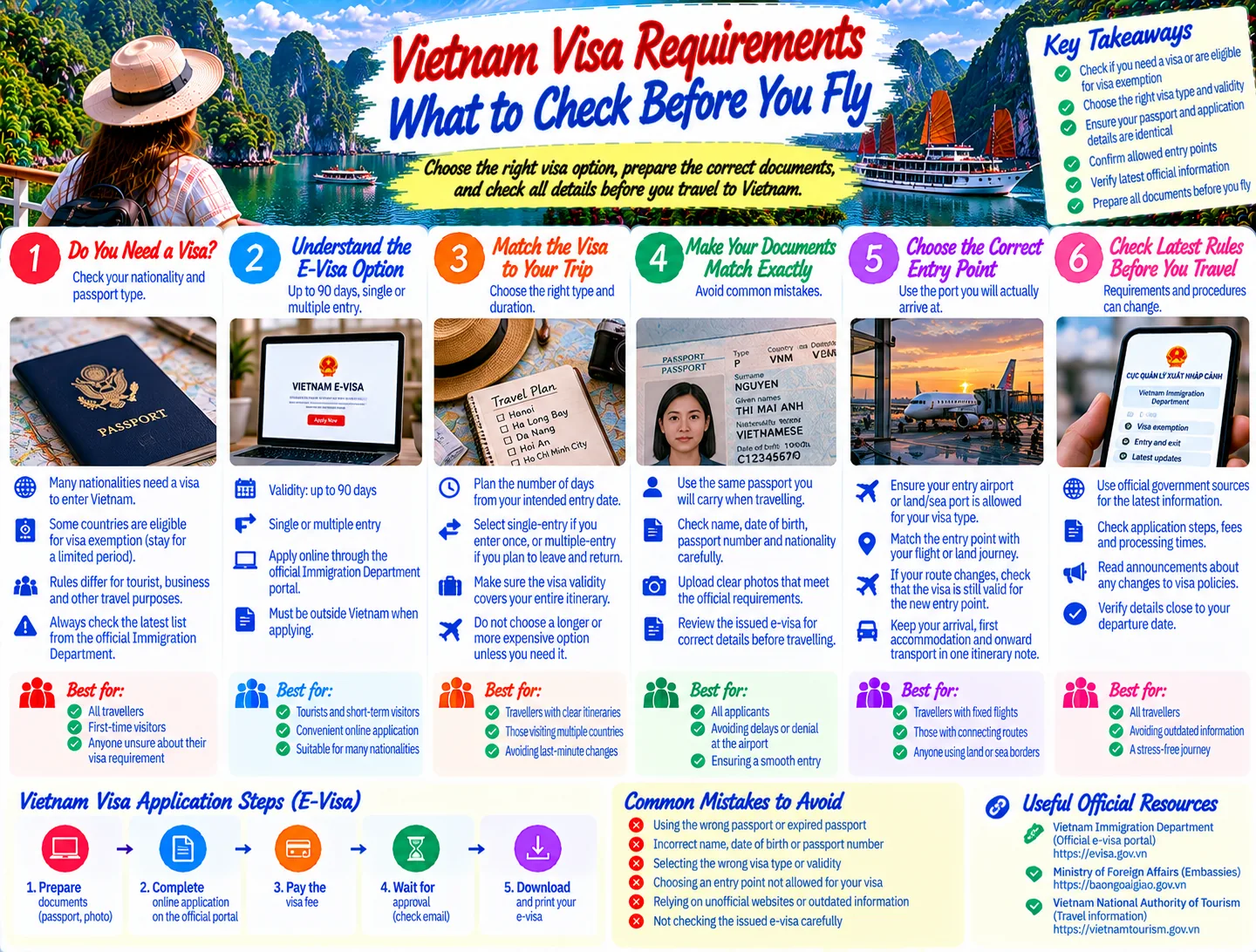
Vietnam visa requirements are easier to manage when you treat them as a document-matching exercise rather than a last-minute form. The key is to choose the entry route that fits your passport and trip, then make every detail agree across your passport, application, approval document and flight plan. Vietnam’s Immigration Department says an electronic visa can be issued for up to 90 days with single or multiple entry, while the Vietnamese Embassy in the United States describes e-visa and embassy applications as separate routes. Rules and portal instructions can change, so use this guide as a planning framework and verify the live official instructions before payment.
Start with the right Vietnam visa route
The first question is not “How quickly can I complete the form?” It is “Do I need an e-visa, an exemption, or another visa process?” Your nationality, passport type, purpose of travel and intended length of stay all matter. A tourist arriving for a holiday should not assume that advice for business visitors, diplomatic passports or people sponsored by a Vietnamese organization applies to them.
The official Immigration Department page explains that people outside Vietnam may apply personally for an e-visa or through a requesting agency or organization. It also lists a valid passport and being outside Vietnam among the stated conditions for e-visa consideration. Make a pre-check:
Confirm the nationality and passport type you will use for the trip.
Check whether your itinerary needs single-entry or multiple-entry permission.
Count the intended stay from the date you expect to enter, not from the date you submit the form.
Identify every country you may visit between Vietnam entries.
For the wider preparation sequence, see Vietnam visa and entry requirements and the Essential Vietnam Travel Tips category. Those resources help connect your entry paperwork with the rest of your pre-trip planning.
Understand what an e-visa actually covers
An e-visa is permission to travel to Vietnam and request entry under the terms shown on the issued document; it is not a guarantee that every detail of an application will be accepted automatically. The Immigration Department describes Vietnam’s e-visa as an electronic visa issued through its system, with a maximum validity of 90 days and either single or multiple entry.
That distinction matters when you build an itinerary. A multiple-entry visa can be relevant if you plan to leave Vietnam for a nearby country and return, but you still need to make sure the visa validity covers the return date. If your trip is a straightforward arrival followed by departure, single entry may match the plan. Do not select an option simply because it sounds more flexible; select the option that matches the movements you can realistically explain.
Read the issued document rather than relying on a confirmation email or a saved screenshot of the application form. Check the name, passport number, date of birth, entry type, permitted dates and any other printed details before travel. If something is wrong, resolve it through the official channel before you reach the airport.
Make your passport and application details identical
Many avoidable visa problems begin with small inconsistencies. Use the passport that you will carry into Vietnam, and copy its biographical details carefully. Pay attention to the order of names, spelling, date format, passport number and nationality. Do not use a nickname in one field and a legal name in another.
Before submitting, compare the application against the passport photo page line by line. Confirm that the document is valid for the planned journey and that you will not replace it after applying unless you have checked what that means for the visa. A visa associated with one passport should not be assumed to transfer to a replacement passport.
Prepare the digital files requested by the official portal in advance, using clear images and the current specifications shown on the form. Avoid editing a portrait or passport scan so heavily that important details become unclear. Keep the original files, the submitted application information and the final issued document together in one trip folder.
A useful second reading is Preparing Your Vietnam Entry Documents. It complements this guide by helping you turn the application into a complete travel-document set rather than a single file.
Choose entry points from your real itinerary
Vietnam visa planning is not finished when the visa is approved. Your intended entry point must make sense for the flight or land journey you have booked. If you are flying to Hanoi, Ho Chi Minh City or another international gateway, check the current list of airports and other ports accepted for the visa type shown on the official Immigration Department information.
Do not choose an entry point because it is geographically close to your hotel. Choose the port where you will actually present yourself for immigration. A domestic connection after an international arrival is a different planning problem from a direct international arrival, and a border crossing is different again. Keep your arrival airport, first accommodation and onward transport in the same itinerary note so a last-minute change is easy to spot.
If your airline changes the route, review the visa details before accepting the replacement. A new connection can alter the country where you first board, the airport where you enter Vietnam or whether the itinerary still fits the visa’s stated entry conditions. For transport planning after immigration, use the site’s guide to trains, flights, buses and more and the Transportation in Vietnam category.
Build timing around the issued document
Do not treat submission as approval. The official portal states that the fee is paid through an electronic payment gateway and will not be refunded if an application is refused. That makes accuracy more valuable than speed. Submit with enough time to review the result, correct a problem if the responsible authority gives you a route to do so, and contact your airline or accommodation if the trip has to move.
Keep the application reference information safe, but do not confuse a reference number with a visa. Check the result through the official system and download the issued document from the source you used. Save a readable offline copy on your phone and carry a printed copy as a practical backup, especially if your itinerary includes several flights or weak internet access.
Leave room between visa approval and departure when possible. A rushed application can turn a small typo into a missed flight, while a little schedule flexibility gives you time to compare the issued dates with your booking. If the trip is fixed around a cruise, tour or event, make the entry document the first dependency in the booking chain.
Know when embassy or sponsored routes may matter
The Vietnamese Embassy in the United States describes two broad application paths: applying at the Embassy for a standard visa, or applying through the Immigration Department for an e-visa. Its guidance also notes that some applicants may need an inviting or guaranteeing organization, and that the Embassy can request additional information or documentation.
This is why generic “everyone can use the same visa” advice is risky. A traveler with an unusual passport, a non-tourist purpose, a sponsorship requirement or a case that does not fit the e-visa instructions should stop and ask the relevant official authority which route applies. Do not pay an unofficial intermediary simply because a search result promises guaranteed approval.
If you use an agency, understand what it is doing and which government portal or authority ultimately issues the document. Keep copies of the information submitted on your behalf. The applicant remains responsible for noticing an incorrect name, passport number, date or entry detail before departure.
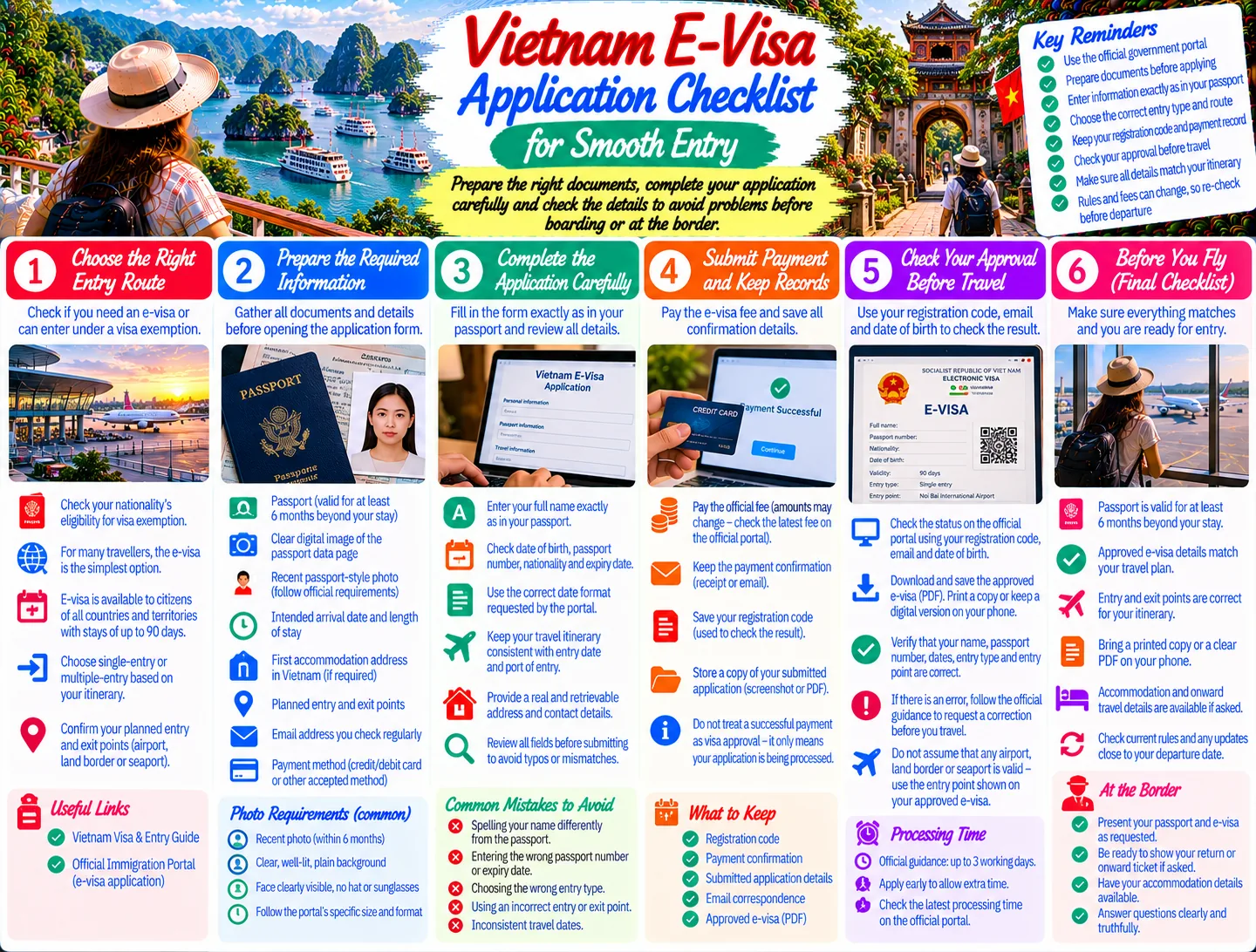
Run a final Vietnam entry checklist
Seven days before departure, compare the visa with the passport you will carry. Confirm the entry date falls within the permitted period and that the number of entries matches the route. Check the arrival port against the flight booking, and make sure every traveler in a group has the correct document for their own passport.
Passport details match the issued visa exactly.
The visa is valid on the planned arrival date.
The entry type matches the complete itinerary.
The intended airport, land port or seaport is accepted for your document.
The visa result is saved offline and printed if practical.
Application references, payment records and official contact details are stored securely.
Any change to flights, passport or entry route has been checked against the current rules.
At the airport, keep your passport, visa copy and onward itinerary accessible. Answer questions consistently and avoid presenting an old document when a newer issued version exists. If an officer or airline agent identifies a discrepancy, ask what official correction or clarification is required rather than improvising.
Use official sources for the last-minute check
Visa rules are time-sensitive. The Immigration Department’s information page currently directs applicants to the newer electronic visa domains, including evisa.gov.vn and thithucdientu.gov.vn, for applications and result checks. The same page explains the 90-day maximum and the single- or multiple-entry options. The Embassy’s consular guidance provides a separate route for Embassy applications and contact details for questions related to that process.
Check those official pages shortly before submitting and again before departure. Avoid relying on a travel forum, an old blog or a social-media post when the question concerns eligibility, payment, entry ports or a current domain. A useful travel guide can explain the workflow, but only the responsible authority can confirm how a current rule applies to your passport and case.
Keep a backup plan for changes
Travel arrangements can shift after the application is submitted. A delayed passport renewal, a changed flight, a new stop in another country or a longer stay can alter the assumptions behind the original form. Keep a short change log with the original itinerary, the current itinerary and the visa details. This makes it easier to see whether the entry date, port or number of entries needs a fresh official check.
Do not edit a downloaded visa yourself or assume that an airline booking change updates an immigration record. If the passport is lost or replaced, contact the relevant authority before travel and ask what documentation is required. If an airline representative gives advice that conflicts with the official portal, request the specific rule or instruction and verify it through the responsible authority. Planning a backup is not pessimism; it is a way to avoid discovering a mismatch at check-in.
Conclusion: make the visa match the trip
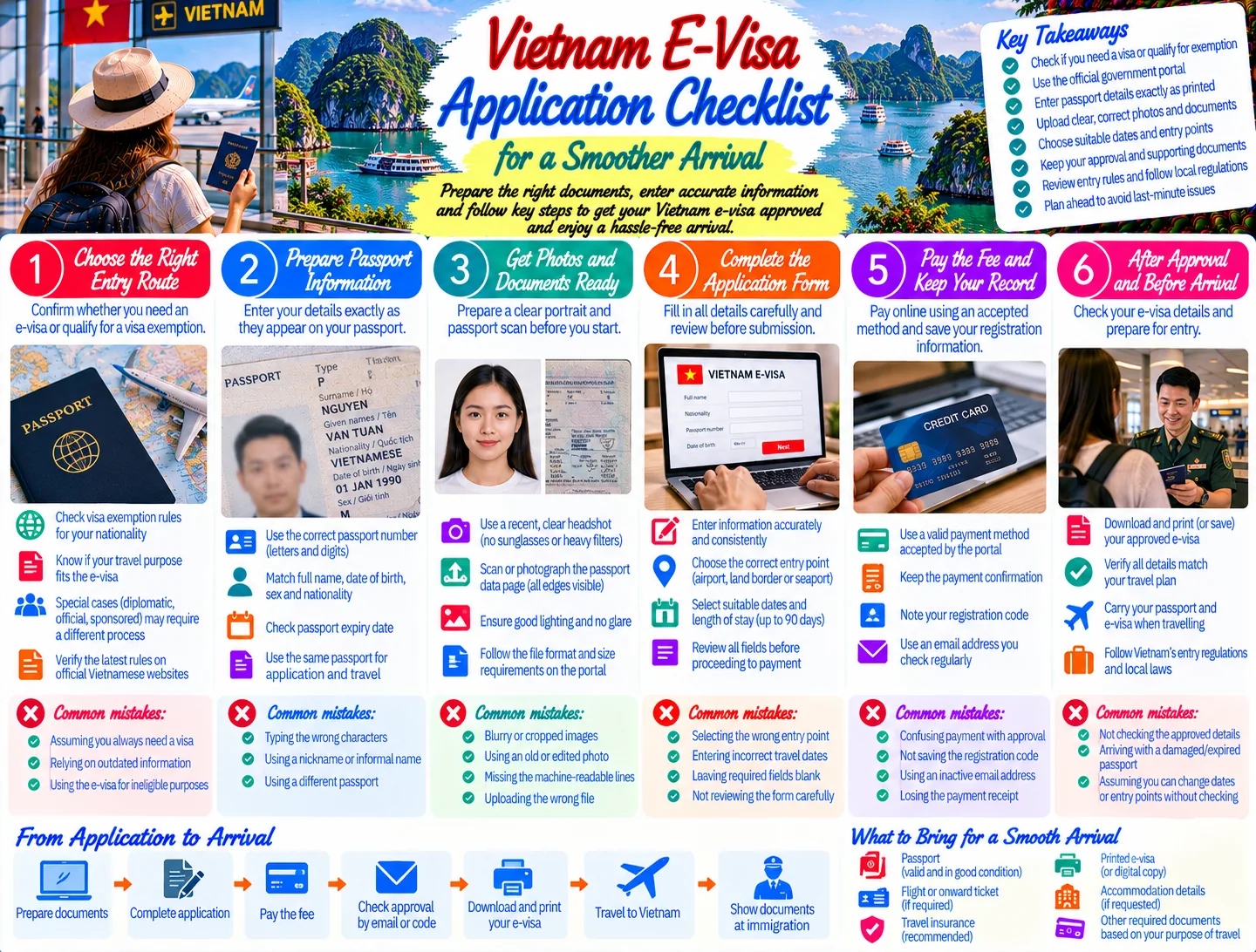
The safest approach to Vietnam visa requirements is simple: choose the correct route, copy your passport details precisely, select an entry point that matches your actual journey, allow time for the issued result, and check the document again before flying. Treat the visa as one part of a connected travel file, not as an isolated form. With those checks complete, you can move on to the more enjoyable work of planning where to stay, how to travel and what to see after you arrive.
JOIN THE CONVERSATION
Comments (0)
No comments yet. Be the first to share a thought.